















Table of Contents
- What Is NetSuite Certification?
- Why NetSuite Certification Matters for Finance Professionals
- The NetSuite Certification Program: Key Credentials for Finance Teams
- How to Prepare for NetSuite Certification Exams
- Building the Business Case for Team Certification
- Optimize Your NetSuite Investment With Paystand's Autonomous AR
- Frequently Asked Questions
Key Takeaways
- NetSuite certification validates technical and functional expertise across finance, administration, implementation, and analytics—with credentials ranging from SuiteFoundation to specialized Financial User and ERP Consultant tracks
- Finance professionals benefit most from Administrator, Financial User, and SuiteAnalytics certifications, which directly improve AR operations, financial reporting accuracy, and month-end efficiency
- Certification preparation requires 40-80 hours of hands-on NetSuite solution experience combined with Oracle University training modules and practice exams covering real-world scenarios
- Organizations with certified NetSuite users report 30-40% faster system adoption, reduced customization costs, and better ROI from their ERP investment
- While certification maximizes NetSuite capabilities, finance teams still need zero-touch automation for payments, cash application, and reconciliation—areas where native ERP functionality falls short
Many finance organizations invest heavily in NetSuite implementation, only to discover their teams struggle with suboptimal configurations, manual workarounds, and untapped automation potential. The NetSuite certification program addresses this gap by validating that users—from administrators to financial analysts—possess the skills to extract maximum value from the platform.
For controllers and finance leaders, the question isn't whether NetSuite knowledge matters. It's whether formal certification delivers meaningful operational improvements. The answer depends on understanding which credentials align with your team's responsibilities, how certification translates into measurable efficiency gains, and where even advanced NetSuite expertise still requires external automation to eliminate manual work.
What Is NetSuite Certification?
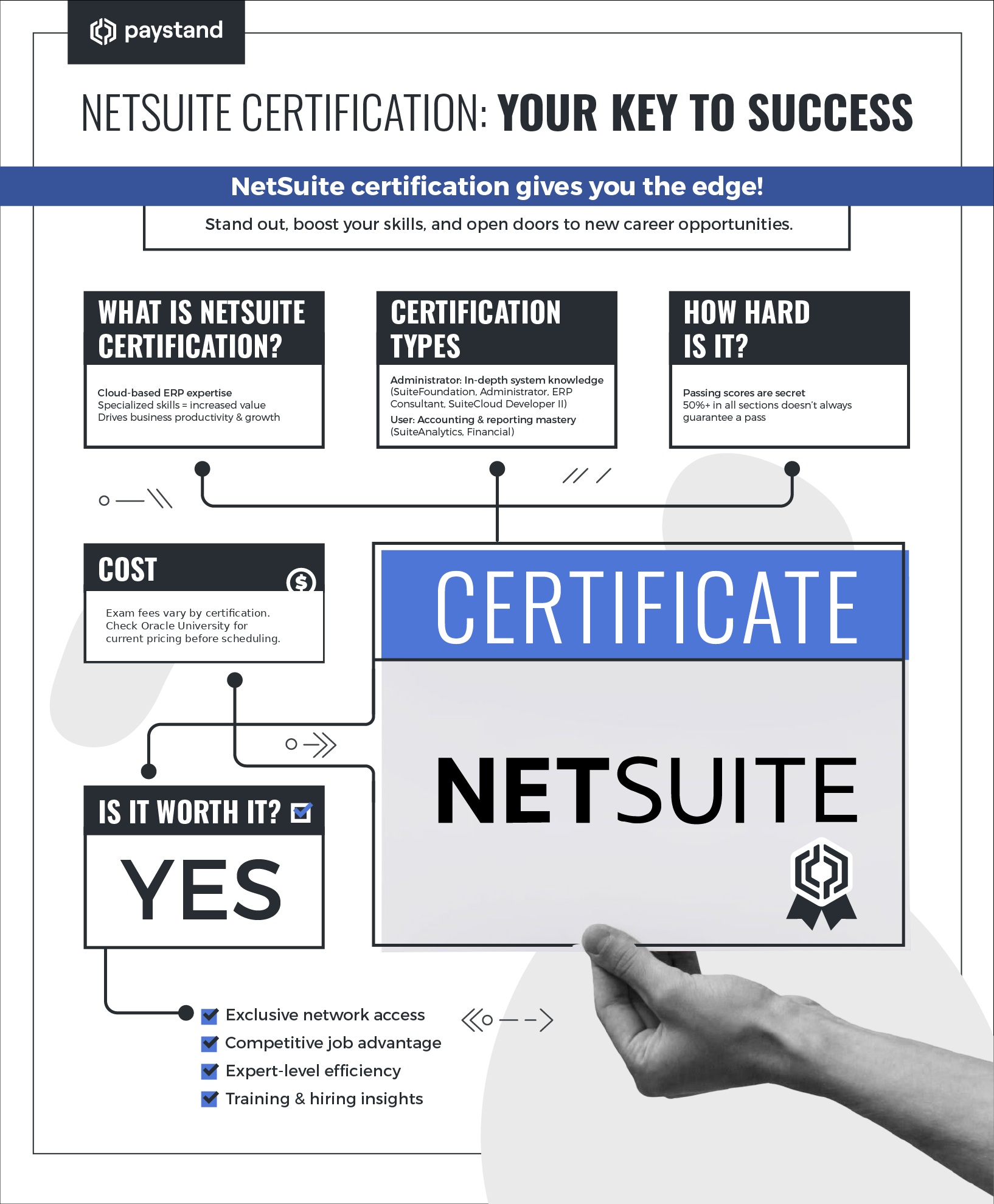
NetSuite certification is Oracle's official credential program that validates proficiency in implementing, administering, and using the NetSuite ERP platform. These credentials demonstrate that professionals understand both the technical architecture and functional business processes within NetSuite's cloud-based financial management environment.
The Structure of NetSuite Certification
Oracle University administers the NetSuite certification program through proctored exams testing real-world scenarios across multiple competency areas. Each certification requires passing a specific exam—typically 77-80 multiple-choice and scenario-based questions completed within 120-135 minutes. Unlike generic ERP training, NetSuite certification exams focus on practical application: configuring workflows, building saved searches, interpreting financial reports, and troubleshooting common implementation challenges.
Certifications fall into four categories: foundational credentials for all users, administrator tracks for system management, functional certifications for finance and operations roles, and specialized consultant certifications for implementation partners. This tiered structure ensures that AR managers pursuing Financial User certification study different material than NetSuite administrators preparing for SuiteCloud Developer credentials.
Who Pursues NetSuite Certification
Three groups dominate the certified NetSuite user base. Implementation consultants and NetSuite partners pursue certification to demonstrate expertise when selling and deploying NetSuite solutions. In-house administrators earn credentials to manage system configurations, user permissions, and customizations without constant reliance on external consultants. Finance professionals—controllers, AR managers, AP managers, and financial analysts—increasingly pursue certification to optimize their own workflows, build sophisticated reports, and reduce dependence on IT for routine system modifications.
The shift toward finance-team certification reflects a broader trend: organizations recognize that deep NetSuite knowledge within the finance department directly improves data accuracy, accelerates month-end close, and enables finance leaders to independently adapt the system as business requirements evolve.

Why NetSuite Certification Matters for Finance Professionals
Finance teams face a persistent challenge: they understand the business logic behind revenue recognition, cash application, and three-way matching, but lack the technical NetSuite skills to automate these processes without IT intervention. NetSuite certification bridges this gap, empowering finance professionals to configure workflows, build custom reports, and optimize AR and AP operations without submitting help desk tickets.
Direct Impact on AR and AP Efficiency
Certified NetSuite Financial Users can independently configure payment terms, set up automatic dunning workflows, and create saved searches that flag overdue invoices or duplicate vendor records. A mid-sized manufacturing company processing 850 invoices monthly might see its AR team spend 12-15 hours each week on manual follow-up. After certification, that same team configures automated email reminders triggered by aging buckets, builds dashboard reports showing DSO trends by customer segment, and sets up alerts for payment exceptions—reclaiming 8-10 hours weekly without adding headcount.
The difference is control. Non-certified users submit requests to administrators for every workflow adjustment. Certified users modify aging period definitions, adjust collection sequences, and refine search criteria themselves. This autonomy accelerates process improvements from weeks to hours.
Better Financial Reporting and Month-End Close
Controllers and finance managers with NetSuite SuiteAnalytics certification build multi-dimensional reports combining GL data, customer aging, inventory valuations, and revenue recognition schedules—analysis that previously required exporting raw data to Excel for manual pivot tables. Certified users leverage NetSuite's built-in reporting engine to create real-time dashboards that automatically update as transactions post, eliminating the two-to-three-day lag common in organizations where finance teams wait for IT to generate custom reports.
Month-end close processes compress when finance teams can independently verify account reconciliations, identify variances, and drill down into transaction details without relying on system administrators to build one-off queries. Organizations report 25-30% faster close cycles after finance teams complete NetSuite certification.
Reduced Customization Costs
NetSuite implementations commonly accumulate expensive customizations because users don't understand native functionality. A company might pay $15,000-25,000 for custom scripting to automate a workflow that standard NetSuite features already support—if users knew how to configure them. Certified administrators recognize when native saved searches, workflow actions, or SuiteFlow capabilities solve requirements without custom code, directly reducing reliance on external NetSuite developers charging $150-200 per hour.
Finance leaders building the case for certification can model these savings concretely. Assume a conservative estimate of four customization projects annually at $12,000 each. If certification prevents just half of those projects by enabling in-house configuration, the organization saves $24,000 while gaining faster implementation of process improvements.
The NetSuite Certification Program: Key Credentials for Finance Teams
Oracle University offers more than a dozen NetSuite certifications, but finance professionals should focus on credentials that directly improve financial operations, reporting, and payment workflows. Understanding which certifications align with specific roles prevents teams from pursuing credentials that emphasize technical development over functional finance expertise.
NetSuite Certification Comparison for Finance Teams
|
Certification |
Best For |
Key Skills Validated |
Current Exam Details |
Business Impact |
|
NetSuite SuiteFoundation Specialist |
New NetSuite users, AR/AP coordinators, finance operations staff, aspiring admins or consultants |
Core NetSuite concepts, navigation, standard functionality, business process awareness |
65 questions, 90 minutes, 55% passing score. Designed for users with 6–12 months of hands-on and implementation experience. (Oracle University) |
Builds baseline NetSuite literacy so finance teams can better navigate invoice, payment, customer, vendor, and reporting workflows. |
|
NetSuite Administrator Professional |
NetSuite admins, finance operations leads, system owners |
Configuration, system maintenance, user and role management, optimization across departments |
60 questions, 90 minutes, 55% passing score. Designed for candidates with 1–2 years of NetSuite experience. (Oracle University) |
Helps internal teams manage permissions, workflows, saved searches, alerts, and routine configuration without over-relying on outside consultants. |
|
Oracle NetSuite Certified Financial User |
Accounting managers, controllers, senior finance users |
Core accounting and finance capabilities, accounting features, standard accounting process flows |
30 questions, 60 minutes, 65% passing score. Designed for users with 6–12 months of NetSuite Financials experience. (Oracle University) |
Supports stronger day-to-day financial operations, reporting confidence, and accounting process understanding inside NetSuite. |
|
NetSuite Accounting Professional |
Controllers, accounting leaders, experienced NetSuite finance users |
Advanced accounting processes, complex workflows, compliance, financial operations insight |
60 questions, 90 minutes, 65% passing score. Validated against NetSuite Release 24.1. (Oracle University) |
Better fit than Financial User for advanced accounting leadership topics such as complex finance workflows and strategic accounting operations. |
|
Oracle NetSuite Certified SuiteAnalytics User |
Financial analysts, FP&A teams, reporting users |
NetSuite reporting, analytics tools, data structure, business decision support |
30 questions, 60 minutes, 70% passing score. Designed for users with 6–12 months of NetSuite reporting and analytics experience. (Oracle University) |
Helps finance teams build stronger reports, dashboards, and analytics workflows without waiting on IT or external reporting support. |
|
NetSuite BI and Reporting Associate |
Analysts, FP&A teams, finance reporting owners |
Searches, reports, dashboards, foundational reporting knowledge |
60 questions, 90 minutes, 65% passing score. Designed for candidates with 3–6 months of NetSuite experience. (Oracle University) |
Good entry point for teams that need stronger visibility into AR, DSO, cash flow, payment status, and finance performance. |
|
NetSuite BI and Reporting Specialist |
Experienced analysts, FP&A teams, reporting owners |
Advanced reporting, searches, dashboards, reporting best practices, actionable insights |
50 questions, 90 minutes, 65% passing score. Designed for candidates with 6–12 months of NetSuite experience. (Oracle University) |
Stronger fit for finance teams building advanced dashboards and operational reporting workflows. |
Choosing the Right Certification Path
Finance teams should view NetSuite SuiteFoundation Specialist as prerequisite knowledge, not the end goal. AR coordinators and AP clerks benefit from this certification because it establishes baseline competency, but controllers and finance managers need more specialized credentials to optimize financial operations.
The most valuable certifications for finance departments include Oracle NetSuite Certified Financial User for day-to-day accounting capabilities, NetSuite Accounting Professional for advanced finance workflows, Administrator Professional for workflow control, and Oracle NetSuite Certified SuiteAnalytics User or NetSuite BI and Reporting Associate/Specialist for advanced reporting and dashboard capabilities. Organizations processing high volumes of transactions—consider a distributor handling 1,200 vendor invoices monthly—benefit significantly when their AP manager holds Administrator certification and can independently adjust three-way matching rules or configure automatic invoice approval for low-dollar POs.
Certified Financial Users can adjust accounting periods, set up custom consolidation rules, and modify chart of accounts structures without submitting requests to NetSuite consultants. This autonomy translates directly into faster month-end close cycles and reduced dependence on external support.
How to Prepare for NetSuite Certification Exams
NetSuite certification exams test real-world problem-solving, not memorization of feature lists. Effective preparation requires hands-on system experience, structured training, and focused practice on the specific workflows and scenarios emphasized in each credential's exam blueprint.
Hands-On NetSuite Experience Requirements
Oracle recommends 40-80 hours of direct NetSuite use before attempting certification exams. This experience should include configuring transactions, building saved searches, generating financial reports, and troubleshooting common user challenges. Finance professionals working daily in NetSuite accumulate this experience naturally, but organizations should still provide dedicated time for certification candidates to explore areas outside their normal job responsibilities.
An AR coordinator preparing for Administrator certification needs practice time to set up workflow rules, configure custom fields, and build dashboard reports—tasks they don't perform in their daily collection activities. Budget 5-10 hours weekly over 8-12 weeks for certification preparation that combines hands-on exploration with formal training.
Oracle University Training Modules
Oracle University offers exam-specific training courses aligned to each certification's content outline. These courses use recorded demonstrations, practice exercises, and scenario-based simulations to build proficiency in tested areas. While training courses are optional, candidates who complete them report 20-25% higher pass rates compared to candidates relying solely on hands-on experience.
Training investments range from $500-1,200 per certification depending on course selection. Organizations should evaluate whether this expense delivers ROI compared to multiple exam retake fees—failed attempts cost $150-250 per exam and delay credential completion.
Practice Exams and Study Resources
NetSuite provides sample questions and practice exams through Oracle University, helping candidates understand question formats and identify knowledge gaps. Effective practice exam use involves more than reviewing correct answers. Candidates should analyze why incorrect responses fail, trace concepts back to specific NetSuite workflows, and practice explaining the logic behind correct choices.
Study groups within finance teams improve preparation efficiency. When three team members pursue certification simultaneously, they can share practice questions, demonstrate workflows to each other, and collaborate on understanding complex topics like revenue recognition configurations or consolidated financial reporting.
Exam Logistics and Scheduling
NetSuite certification exams are delivered through Pearson VUE testing centers or via remote proctoring. Candidates schedule exams after completing training and accumulating sufficient hands-on experience. Exam duration ranges from 120-135 minutes, providing adequate time for careful consideration of scenario-based questions that require candidates to analyze situations and select the best configuration approach among multiple plausible options.
Passing scores vary by certification, typically requiring 68-73% correct responses. Candidates who fail receive diagnostic reports identifying weak content areas, enabling focused restudy before reattempting the exam after Oracle's mandatory waiting period.
Building the Business Case for Team Certification
Finance leaders face budget constraints when proposing team-wide certification initiatives. A compelling business case quantifies certification benefits using metrics that matter to executive stakeholders: reduced consultant spending, faster process improvements, compressed month-end cycles, and improved data accuracy.
Quantifying Consultant Cost Avoidance
Organizations without certified in-house NetSuite expertise pay external consultants $150-200 per hour for configuration changes, custom report development, and troubleshooting that certified users handle independently. Document current annual consultant spending on tasks like building saved searches, modifying workflows, or adjusting financial statement layouts.
Assume a company currently budgets $35,000 annually for NetSuite consultant support addressing routine configuration requests. If certification enables the finance team to handle 60% of these requests internally, the organization saves approximately $21,000 per year while gaining faster turnaround on changes. Balance this saving against certification costs—training fees, exam fees, and staff time—to demonstrate ROI within 12-18 months.
Measuring Process Efficiency Gains
Certification's operational impact extends beyond cost avoidance. Certified finance teams implement process improvements faster because they don't wait for IT resource availability. A controller seeking to automate revenue recognition workflows can design and test the solution in days rather than weeks, accelerating time-to-value for automation initiatives.
Quantify these efficiency gains by tracking current lead times for system modifications. If the average request for a custom report or workflow change requires 15-20 business days from submission to completion, and certification reduces this to 2-3 days for tasks finance can self-serve, the organization gains measurable agility in responding to business changes.
Improving Month-End Close Cycles
Controllers measuring close cycle duration—the time from period-end to final financials—often identify system limitations as bottlenecks. Finance teams wait for administrators to generate reconciliation reports, troubleshoot GL imbalances, or investigate variances between subledgers and the general ledger. NetSuite certification eliminates these delays by enabling finance professionals to independently diagnose and resolve data issues during close.
Organizations shortening close cycles by one to two days through certification gain competitive advantages: faster earnings reporting, quicker identification of financial trends, and reduced period-end overtime costs. A finance team of eight professionals working 10-12 hours of overtime during typical three-day close cycles can reclaim 80-96 overtime hours annually by compressing close to two days—a tangible cost reduction and morale benefit.
Reducing System Adoption Risk
NetSuite implementations fail when users lack platform expertise and default to manual workarounds outside the system. Certification mitigates this risk by ensuring finance teams understand how to use NetSuite effectively from day one. Organizations pursuing NetSuite certification before or during implementation report 30-40% faster user adoption and greater utilization of advanced features compared to companies that skip structured training.

Optimize Your NetSuite Investment With Paystand's Autonomous AR
Paystand brings agentic AI directly into your NetSuite AR workflows — automating the work that still lands on your team after every payment comes in. Collections, cash application, reconciliation. The system handles it; your team doesn't have to.
The integration runs bidirectionally. Invoice data flows from NetSuite into Paystand's payment portal, where customers see open balances and pay without fees. Payment confirmations and remittance details land back in NetSuite instantly, applied to the right invoices and customer accounts — with AI handling the matching, routing, and reconciliation in real time, no manual hand-holding required.
The results compound as volume grows. Organizations on Paystand see 50–60% reductions in AR processing time and a 40% compression in DSO — on top of eliminating the 2–3% credit card fees draining every transaction. For teams already invested in NetSuite, Paystand doesn't sit on top of it. It makes the whole AR side of that investment run the way it was supposed to.
