











paystand symbol white logoAR + PAYMENTS
|
EXPENSES
|
GLOBAL PAYOUTS
|
LATAM AR + AP
|
.org
  • Receivables

    ACCOUNTS RECEIVABLES

    • Automatic Reconciliation
    • Collections Automation
    • Payment Portal
    • Convenience Fees & Incentives
    • Billing & Receivables Automation
    • Dashboard & Reporting
    • AR Network Portal
    • Virtual Terminal
    • Recurring Payments
    • NetSuite NetSuite
    • Sage Sage
      • Sage Intacct
      • Sage 300
      • Sage 100
      • Sage X3
    • Dynamics 365 Dynamics 365
    • Acumatica Acumatica
    • Adobe Commerce Adobe Commerce
    • BigCommerce BigCommerce
    • Woo Commerce Woo Commerce
    • Xero Xero
    • All Integrations All Integrations
  • Payments

    OUR NETWORK

    Discover how we enable your business to receive fee-less payments at a faster speed than your current solution.

    We transition your costliest payers into cost-effective payment rails to return the most positive of ROIs.

    B2B PAYMENTS
    • USDb
    • Paystand Bank Network
    • Check Scan
    • eCheck and ACH
    • Smart Lockbox
    • Canadian EFT
    • Push Payments (AI Match)
  • Expenses
    EXPENSE
    • Spend Management
    • Corporate Cards
    • Spend Analytics
    • Slack Slack
    • Microsoft Teams Microsoft Teams
    • Quickbooks Online Quickbooks Online
    • NetSuite NetSuite
    • Sage Sage
      • Sage Intacct
      • Sage 300
      • Sage 100
      • Sage X3
    • Microsoft Dynamics 365 Microsoft Dynamics 365
    • All Integrations All Integrations
  • Payables
    ACCOUNTS payables
    • AP Automation
    • Accounting Automation
    • Cross-Border Payments
    • Spend Approvals

    WHY NOW

    Our push into Accounts Payables comes with our mission of becoming the one stop shop for the CFO.

    By integrating AP, our financial suite becomes even more powerful as we aim to automate everything money.

  • Resources
    • Blog
    • Case Studies
    • Glossary
    • Podcast

    Why Paystand

    • Comparisons
    • Events
    • Webinars
    • Datasheets
    • eGuides


    • Reviews

    INDUSTRIES

    • Healthcare
    • Manufacturing
    • Construction
    • Supply Chain
    • Solar Energies
    • Retail
    • Wholesale

    DATA & INFRASTRUCTURE

    • Enterprise Blockchain

    LEARNING RESOURCES

    • Improving Cash Flow
    • Optimizing AR
    • Reducing Costs
    • Bitcoin at Paystand
  • Company

    Company

    Paystand is revolutionizing B2B payments with a modern infrastructure built as a SaaS on the blockchain, enabling faster, cheaper, and more secure business transactions.

    Our mission is to reboot commercial finance by creating an open financial system.

    Payments as a Service

    PARTNERS

    Join Paystand's partnership program today.

    Become a Partner

    PRESS

    Read about Paystand business updates and technology announcements.

    Read About Paystand

    CAREERS

    Join our fast-growing team of disruptors and visionaries.

    Grow With Paystand

    ABOUT US

    See how we are rebooting commercial finance.

    Learn About Our Mission

    Where We Operate

    United states

    USAPaystand is headquartered in California and operates nationwide, serving businesses across all 50 states.


    canada

    CANADAWe support operations in Canada with localized payment capabilities, including CAD EFT and cross-border support.

Bitcoin
Talk to an Expert
  • Login
  • Receivables
    • Receivables
    • Automatic Reconciliation
    • Collections Automation
    • Payment Portal
    • AR Network Portal
    • Virtual Terminal
    • Recurring Payments
    • Convenience Fees and Incentives
    • Billing & Receivables Automation
    • Dashboard & Reporting
    • NetSuite
    • Sage
      • Sage Intacct
      • Sage 300
      • Sage 100
      • Sage X3
    • Dynamics 365
    • Acumatica
    • Adobe Commerce
    • BigCommerce
    • WooCommerce
    • Xero
    • All Integrations
  • Payments
    • B2B Payments
    • USDb
    • Paystand Bank Network
    • Check Scan
    • eCheck and ACH
    • Smart Lockbox
    • Canadian EFT
    • Push Payments: AI Match
  • Expenses
    • Expenses
    • Spend Management
    • Corporate Cards
    • Spend Analytics
    • Slack
    • Microsoft Teams
    • Quickbooks Online
    • NetSuite
    • Sage
      • Sage Intacct
      • Sage 300
      • Sage 100
      • Sage X3
    • Microsoft Dynamics 365
    • All Integrations
  • Payables
    • Payables
    • AP Automation
    • Accounting Automation
    • Cross-Border Payments
    • Spend Approvals
  • Resources
    • Blog
    • Case Studies
    • Datasheets
    • eGuides
    • Comparisons
    • Events
    • Webinars
    • Glossary
    • Podcasts
    • Improving Cash Flow
    • Optimizing AR
    • Reducing Costs
    • Bitcoin at Paystand
    • The Future of Finance - Get Your Copy
    • Enterprise Blockchain
  • Why Paystand
    • Comparisons
    • Reviews
  • Industries
    • Healthcare
    • Manufacturing
    • Construction
    • Supply Chain
    • Retail
    • Solar
    • Wholesale
  • Company
    • Abous Us
    • Payments as a Service
    • Become a Partner
    • Press
    • Careers
  • Login
  • Get Started
Vivek Shankar 08/26/2026
6 Minutes

Why Your Cash Flow Forecast Keeps Getting It Wrong and How to Fix It

Why Your Cash Flow Forecast Keeps Getting It Wrong and How to Fix It

Table of Contents

  1. Why Your Cash Flow Forecast Keeps Getting It Wrong

  2. The Inputs an Accurate Cash Forecast Depends On

  3. How to Build a Cash Flow Forecast That Reflects Real Movement

  4. Useful Cash Flow Forecast Templates

  5. Clean Books And A Clean Cash Position

  6. Frequently Asked Questions

Key Takeaways

  • Cash flow forecasts are structurally inaccurate because they are built on stale invoice data and unresolved reconciliation gaps rather than real-time cash movement.
  • The three core inputs that determine forecast reliability are precisely what traditional accounting snapshots fail to capture.
  • Forecast error is not a correctable nuisance but an open-ended liquidity risk, as CFOs and treasury teams make financing, payroll, and supplier decisions on positions that were already approximate before those commitments were made.
  • Accurate forecasting requires addressing the problem at the payment infrastructure level so that every projection starts from a current, matched cash position rather than an estimate.

How often have you finished the close but felt your cash flow forecast is already wrong? 24% of respondents ot our survey listed cash cash flow visibility and forecasting as the biggest pain point. Inaccurate cash information creates open-ended risk.

Controllers who finish a clean month-end still build their cash projections on invoice settlement status that likely reflects last week, payer behavior that the ledger treats as static, and reconciliation gaps the system hasn't surfaced yet.

What results is an educated guess shared before the numbers have caught up to reality. The problem is static accounting assumptions built into how forecasting has always worked.

Why Your Cash Flow Forecast Keeps Getting It Wrong

The forecast isn't broken because the math is wrong. It's most likely broken because the data feeding it reflects where invoices stood at last close, not where cash actually sits today.

Controllers catch the mismatch after the fact, then rebuild from aging reports that are already behind. When data assembles after money moves rather than moving with it, the starting position becomes an estimate, and every projection built on that estimate inherits the same gap.

Static accounting snapshots capture three variables as fixed points.

Invoice status changes daily: a disputed line item likely holds a payment that the AR team won't catch until the next aging report runs.

Payer behavior is a pattern that needs deep analysis. A customer who routinely pays 15 days past terms will probably do so again, and the controller carries that gap in the forecast.

Settlement timing compounds both: an expected date that slips two days multiplies across a portfolio.


Cash Positioning vs. Forecasting

Cash positioning and cash flow forecasting are related but distinct activities. Positioning answers what you have today; forecasting answers what you will have next week or next quarter.

A projection is only as reliable as the starting balance it builds from, and an unreconciled starting position likely introduces error before the first assumption is even applied. When cash is applied and matched at settlement rather than at close, the opening balance stops being an estimate.

A CFO building a 30-day outlook on an approximate starting position is compounding uncertainty from the first line.
 

The finance stack of top performing companies


The Inputs an Accurate Cash Forecast Depends On

A forecast is only as trustworthy as the data feeding it. Controllers working from stale AR aging reports, untracked payer behavior, and uncertain settlement windows most likely carry those gaps straight into their projections. Each section below covers one input class and the specific failure mode it creates when missing.


Inflows You Can't Predict Without Live Receivables Data

The inflow line is only as reliable as the receivables data behind it. A static AR aging report tells a CFO where invoices stood at the last close, which is probably not where they stand when the forecast gets built.

Invoices get disputed, partially paid, or quietly ignored between reporting cycles, and the AR team absorbs those gaps without any update reaching the forecast. When live invoice status, applied cash, and collections signals feed the inflow estimate directly, the number reflects what is moving rather than what a report suggested was outstanding two weeks ago.


Outflows, Payables, and Committed Spend

Outflows are the most tractable side of the forecast. Scheduled payables, approved purchase orders, payroll, and recurring obligations are largely known commitments, and controllers who capture them at source rather than reconstructing them at close give the forecast a reliable floor.

The main risk here is timing: AP teams that track due dates by vendor terms catch payment windows before gaps open, not after.


Settlement Timing

Timing breaks forecasts. A controller who knows exactly how much a customer owes still cannot close a reliable position if that payment could settle today, tomorrow, or four days from now.

Across a portfolio of outstanding invoices, that uncertainty compounds: the projected inflow line likely lands somewhere in a multi-day range, and AR teams scramble to cover gaps that the amount-based forecast never flagged. A rail with predictable, tight settlement windows removes that variable entirely.


Reconciliation as the Foundation of a Trustworthy Position

Reconciliation cadence determines whether a cash position is current or approximate. When deposits match to invoices and post to the ERP at settlement, a controller checking the position mid-period reads an actual number.

When reconciliation waits for close, every intraperiod check is an estimate built on what the books looked like last month. The position may be directionally right, but it likely isn't precise enough to act on.


How to Build a Cash Flow Forecast That Reflects Real Movement

Building a forecast that reflects actual cash movement follows a sequence. Controllers should start with live receivables data, weight inflows by payer history, capture committed outflows at source, then calculate the net position.

Each step below covers one input class and the failure it corrects.


Establishing Your Assumptions Against Actual Payer Behavior

Payment terms tell you what customers agreed to. Payment history tells you what they actually do. AR teams that track days-to-pay by customer segment, and by rail, give controllers a calibration point that stated terms never provide.

That segment-level history narrows the inflow assumption gap more than any formula adjustment, and the CFO reading a tighter inflow line is working from observed behavior rather than contractual optimism.


Estimating Inflows From Live Invoice and Settlement Status

DSO averages flatten what payer history reveals. Controllers who weight outstanding invoices by segment-level collection patterns and current invoice status get a timing estimate that reflects how this customer likely pays, not how the average customer theoretically pays.

When live settlement signals show a payment in process, the AR team flags that balance as near-certain. The inflow line tightens because the inputs are current, not because the formula changed.


Estimating Outflows and Committed Spend

Controllers already hold scheduled payables, approved purchase orders, payroll dates, and recurring obligations as confirmed commitments. The risk is timing, not amount: AP teams tracking invoices under variable terms will likely see settlement dates shift within a payment window.


Calculating Net Cash Flow and the Running Ending Balance

Subtract total outflows from total inflows to get net cash flow, then add that figure to the beginning balance. The result is the ending balance, which carries forward as the starting point for the next period.

The variables change; the structure does not.


Comparing Forecast to Actual and Closing the Gap

Comparing forecast to actual is what turns a single projection into a system that gets tighter over time. Controllers who run variance analysis after each period can identify whether shortfalls likely came from timing slippage, collection behavior, or an assumption that was too optimistic.

AR teams surface the patterns. CFOs adjust the inputs. Forecast error narrows.


Useful Cash Flow Forecast Templates


Simple Cash Flow Forecast Template
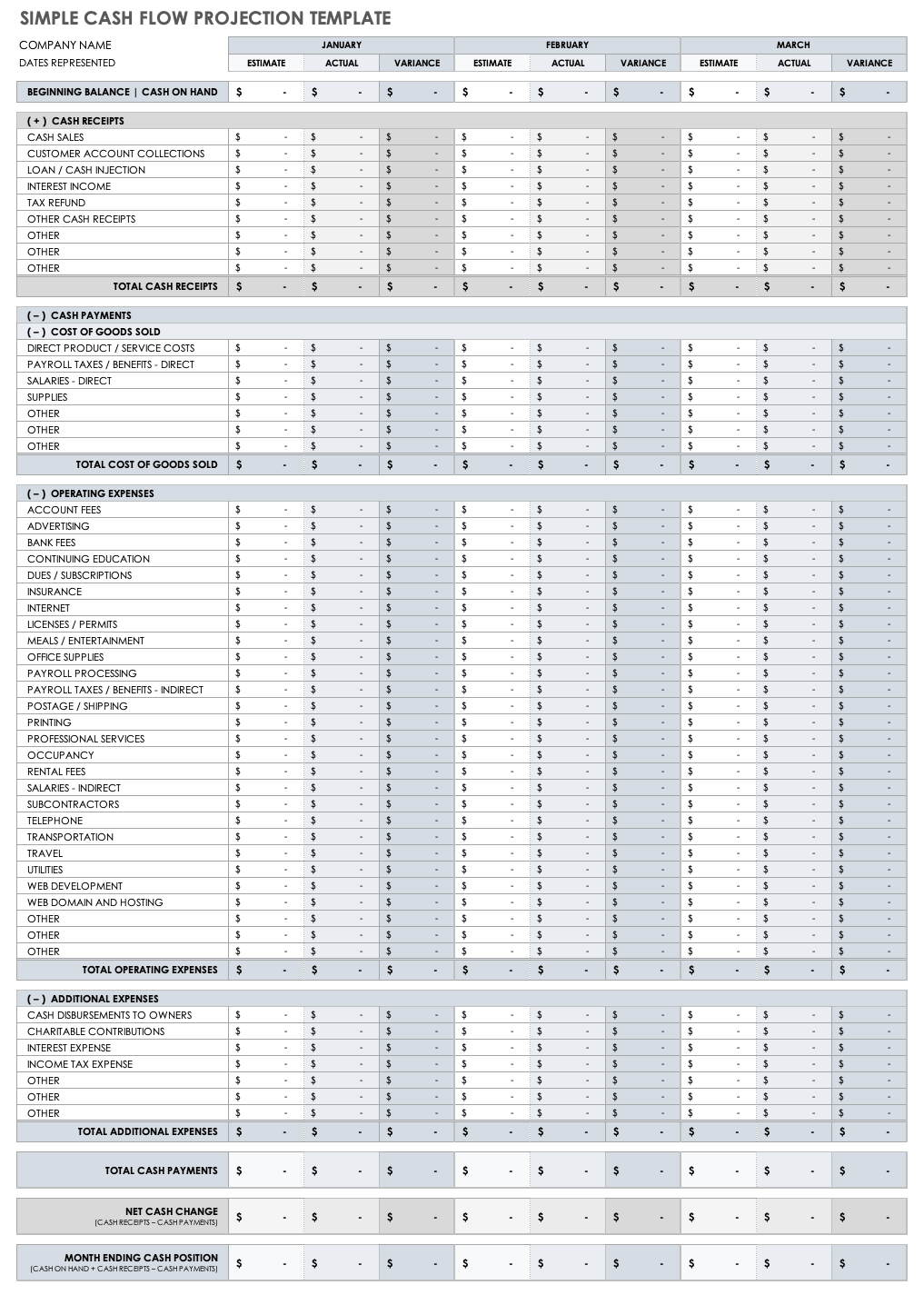
Simple Cash Flow Forecast Template


Small Business Cash Flow Forecast Template

Small Business Cash Flow Forecast Template (1)


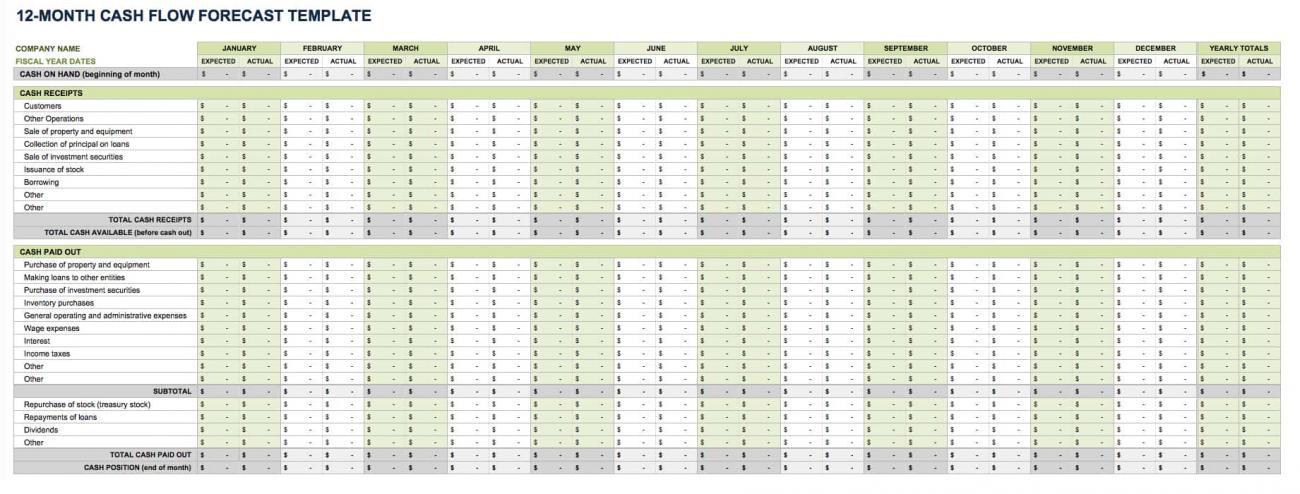
12-Month Cash Flow Forecast Template

12-Month Cash Flow Forecast Template


Daily Cash Flow Forecast Template

Daily Cash Flow Forecast Template (1)


Quarterly Cash Flow Forecast Template
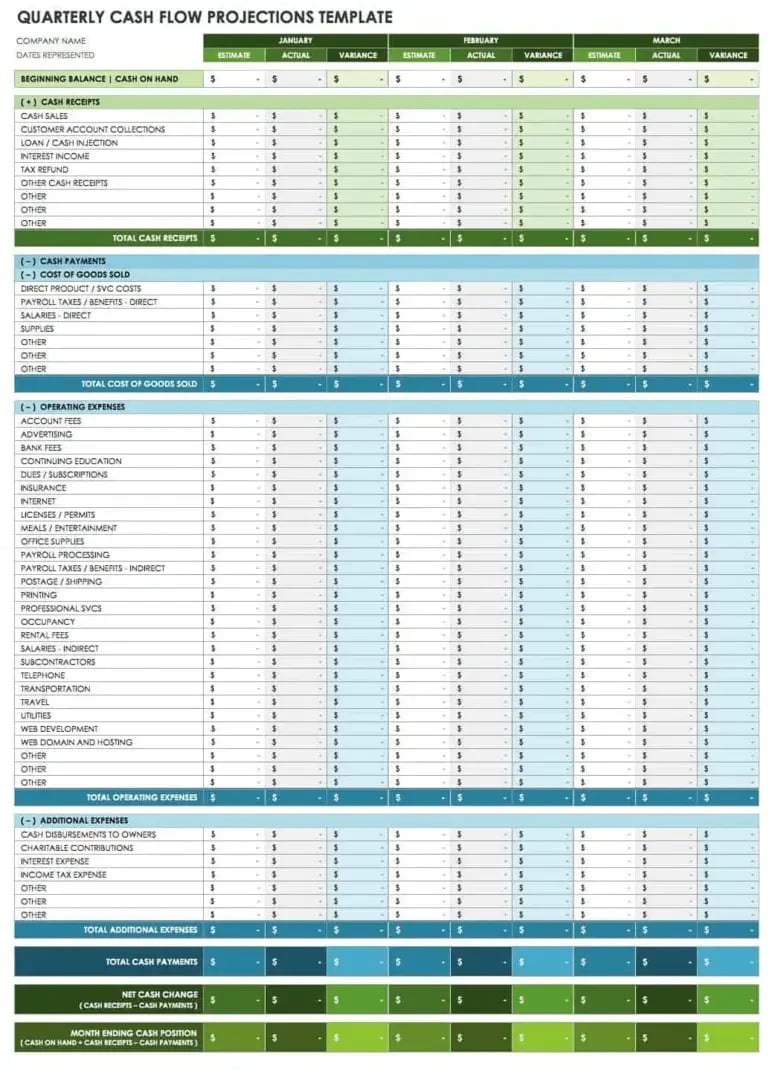
Quarterly Cash Flow Forecast Template


Three-Year Cash Flow Forecast Template
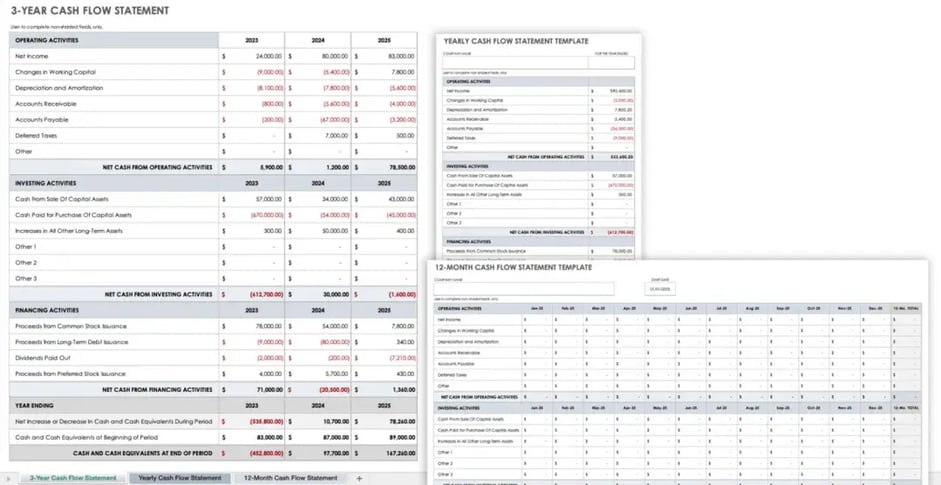
Three-Year Cash Flow Forecast Template


Clean Books And A Clean Cash Position

Static accounting assumptions produce stale forecasts because the underlying data was never current to begin with. We address that at the payment infrastructure level, not the reporting layer.

  • Automatic reconciliation: Controllers close the period against matched, settled data rather than reconstructed estimates.
  • Autonomous cash app: AR teams watch cash apply at settlement and post to the ERP without manual intervention — humans govern by exception.
  • Collections automation: The agentic AI collections agent prioritizes accounts, drafts outreach, and adapts tone by payer; humans supervise and approve every action.
  • Dashboard and reporting: CFOs read live payment status rather than aging snapshots.
  • Native ERP integrations: NetSuite, Sage Intacct, Dynamics 365, and Acumatica receive clean postings at settlement.

Teams that want to see what a forecast built on live settlement data could look like for their business can explore how our AR automation and B2B payment network work together.


 

eBook: Operate Like a Fortune 100 Team


Frequently Asked Questions

How Do You Calculate a Cash Flow Forecast?

The formula is straightforward: ending cash balance equals beginning balance plus net cash flow, where net cash flow is total inflows minus total outflows for the period. IBM confirms this structure holds across forecast horizons and period types. Controllers calculate this figure for each period in the forecast window, and CFOs read the resulting balance to see exactly how many days of runway the business carries before any gap appears.

How Often Should the Forecast Be Updated?

Update frequency should match the decision it serves. Controllers managing short-term liquidity typically refresh weekly or more often; CFOs reviewing medium-term positioning most likely rebuild monthly alongside budget cycles. A rolling structure keeps the near-term window current without requiring a full rebuild each time — controllers advance the window rather than starting over.

What's the Difference Between Rolling and Fixed-Term Forecasts?

A rolling forecast advances with the calendar, holding a constant forward-looking window — thirteen weeks, say — as each week closes. A fixed-term forecast covers a set period and grows staler as that period elapses. Rolling forecasts eliminate the full rebuild that fixed-term cycles require each quarter.

Why Do Forecasts Stay Inaccurate Even With Good Tools?

The tool isn't the problem. Fewer than 20% of companies rate their forecasting capabilities as above average or top-rated, according to research cited by Deloitte, and that number hasn't moved despite years of dashboard upgrades. A faster calculation applied to stale invoice status, untracked payer behavior, and unpredictable settlement timing still produces a stale forecast. The data problem survives the tool.


author-profile
Written by Vivek Shankar

Vivek Shankar specializes in content for fintech and financial services companies. He has a Bachelor's degree in Mechanical Engineering from Ohio State University and previously worked in the financial services sector for JP Morgan Chase, Royal Bank of Scotland, and Freddie Mac. Vivek also covers the institutional FX markets for trade publications eForex and FX Algo News.

Share:

  • Follow us on Facebook
  • Follow us on Twitter
  • Follow us on Linkedin
  • Follow us on Pinterest

Stablecoin vs. Wire Transfer? Choosing the Right Rail for Global B2B Payments

Previous Post
  • There are no suggestions because the search field is empty.

Subscribe Here!

Category

  • B2B Payments (102)
  • AR Optimization (92)
  • AR Automation (90)
  • Billing & Invoicing (69)
  • Payment Processing (64)

Popular Posts

Zazil Martinez 08/22/2024
What Is a TID Number in Payment Processing?
Zazil Martinez 09/23/2024 B2B Payments, AR Automation, AR Optimization
What is Automatic Bill Payment? Benefits, Setup, and Safety
Zazil Martinez 12/19/2024 AR Health
What Is a Write-Off? Understand Its Role in Business Finance
Analisa Flores 03/12/2025 Smart Lockbox
What is a Bank Lockbox Service and How is it Used for Payments?

Related Posts

Billing & Invoicing
Julio Olvera 17 April, 2026

Statement Balance vs Current Balance: How CFOs Manage Payment Timing and Cash Flow

Table of Contents

Read This Article
Billing & Invoicing, AR Automation, AR Optimization, AR Health
Julio Olvera 30 March, 2026

AR Turnover Days: How to Calculate and Reduce Them

Table of Contents

Read This Article
Billing & Invoicing
Analisa Flores 27 March, 2026

Understanding Non-Trade Receivables: A Strategic Finance Guide

Table of Contents

Read This Article

Paystand is on a mission to create a more open financial system, starting with B2B payments. Using blockchain and cloud technology, we pioneered Payments-as-a-Service to digitize and automate your entire cash lifecycle. Our software makes it possible to digitize receivables, automate processing, reduce time-to-cash, eliminate transaction fees, and enable new revenue.

  • Receivables
    • Automatic Reconciliation
    • Collections Automation
    • Payment Portal
    • AR Network Portal
    • Virtual Terminal
    • Recurring Payments
    • Convenience Fees and Incentives
    • Billing & Receivables Automation
    • Dashboard & Reporting
    • NetSuite
    • Sage Intacct
    • Dynamics 365
    • Acumatica
    • Adobe Commerce
    • BigCommerce
    • Woo Commerce
    • Xero
    • All Integrations
  • Payables
    • AP Automation
    • Accounting Automation
    • Cross-Border Payments
    • Spend Approvals
  • Legal
    • Privacy Policy
    • Terms of Service
    • Privacy Requests (DSAR)
  • Your Privacy Choices
    • Support
      • Knowledge Base
      • Developer Hub
    • Payments
      • B2B Payments
      • USDb
      • Paystand Bank Network
      • Check Scan
      • eCheck and ACH
      • Smart Lockbox
      • Canadian EFT
      • Push Payments: AI Match
    • Expense
      • Spend Management
      • Corporate Cards
      • Spend Analytics
      • Slack
      • Microsoft Teams
      • Quickbooks Online
      • NetSuite
      • Sage Intacct
      • Microsoft Dynamics 365
      • All Integrations
    • Company
      • About Us
      • Payments as a Service
      • Become a Partner
      • Careers
      • Press
      • Sitemap
    • Resources
      • Blog
      • Case Studies
      • Datasheets
      • eGuides
      • Comparisons
      • Events
      • Podcast
      • Webinars
      • Glossary
    • WHY PAYSTAND
      • Comparison
      • Reviews
    • INDUSTRIES
      • Healthcare
      • Manufacturing
      • Construction
      • Supply Chain
      • Solar Energies
      • Retail
      • Wholesale
    • DATA & INFRASTRUCTURE
      • Enterprise Blockchain
    • LEARNING RESOURCES
      • Improving Cash Flow
      • Optimizing Accounts Receivable
      • Reducing Costs

    © Paystand, Inc. 2025. All Rights Reserved.