












paystand symbol white logoAR + PAYMENTS
|
AP + EXPENSE
|
LATAM AR + AP
|
FX + PAYOUTS
|
.org
  • Receivables

    ACCOUNTS RECEIVABLES

    • Automatic Reconciliation
    • Collections Automation
    • Payment Portal
    • Convenience Fees & Incentives
    • Billing & Receivables Automation
    • Dashboard & Reporting
    • NetSuite NetSuite
    • Sage Intacct Sage Intacct
    • Dynamics 365 Dynamics 365
    • Acumatica Acumatica
    • Adobe Commerce Adobe Commerce
    • BigCommerce BigCommerce
    • Woo Commerce Woo Commerce
    • Xero Xero
    • All Integrations All Integrations
  • Payables

    ACCOUNTS payables

    • AP Automation
    • Accounting Automation
    • International Payments
    • Purchase Order Approvals & Spend Approvals
    • Customer Portal

    WHY NOW

    Our push into Accounts Payables comes with our mission of becoming the one stop shop for the CFO.

    By integrating AP, our financial suite becomes even more powerful as we aim to automate everything money.

  • Payments

    OUR NETWORK

    Discover how we enable your business to receive fee-less payments at a faster speed than your current solution.

    We transition your costliest payers into cost-effective payment rails to return the most positive of ROIs.

    OVERVIEW

    • B2B Payments
    • Paystand Bank Network
    • Check Scan
    • eCheck and ACH
    • Smart Lockbox
    • Canadian EFT
    • Push Payments (AI Match)
  • Expense

    EXPENSE

    • Spend Management
    • Corporate Cards
    • Procurement
    • Spend Analytics
    • Slack Slack
    • Microsoft Teams Microsoft Teams
    • Quickbooks Online Quickbooks Online
    • NetSuite NetSuite
    • Sage Intacct Sage Intacct
    • Microsoft Dynamics 365 Microsoft Dynamics 365
    • All Integrations All Integrations
  • Resources
    • Blog
    • Case Studies
    • Glossary
    • Podcast
    • Events
    • Webinars
    • Datasheets
    • eGuides

    INDUSTRIES

    • Healthcare
    • Manufacturing
    • Construction
    • Supply Chain
    • Solar Energies
    • Retail
    • Wholesale

    DATA & INFRASTRUCTURE

    • Enterprise Blockchain
    • APIs

    LEARNING RESOURCES

    • Improving Cash Flow
    • Optimizing AR
    • Reducing Costs
    • Bitcoin at Paystand
  • Company

    Company

    Paystand is revolutionizing B2B payments with a modern infrastructure built as a SaaS on the blockchain, enabling faster, cheaper, and more secure business transactions.

    Our mission is to reboot commercial finance by creating an open financial system.

    Payments as a Service

    PARTNERS

    Join Paystand's partnership program today.

    Become a Partner

    PRESS

    Read about Paystand business updates and technology announcements.

    Read About Paystand

    CAREERS

    Join our fast-growing team of disruptors and visionaries.

    Grow With Paystand

    ABOUT US

    See how we are rebooting commercial finance.

    Learn About Our Mission

    Where We Operate

    United states

    USAPaystand is headquartered in California and operates nationwide, serving businesses across all 50 states.


    canada

    CANADAWe support operations in Canada with localized payment capabilities, including CAD EFT and cross-border support.

Bitcoin
Get Started
  • Login
  • Receivables
    • Automatic Reconciliation
    • Collections Automation
    • Payment Portal
    • Convenience Fees and Incentives
    • Billing & Receivables Automation
    • Dashboard & Reporting
    • NetSuite
    • Sage Intacct
    • Dynamics 365
    • Acumatica
    • Adobe Commerce
    • BigCommerce
    • WooCommerce
    • Xero
    • All Integrations
  • Expenses
    • Spend Management
    • Corporate Cards
    • Procurement
    • Spend Analytics
    • Slack
    • Microsoft Teams
    • Quickbooks Online
    • NetSuite
    • Sage Intacct
    • Microsoft Dynamics 365
    • All Integrations
  • Payables
    • AP Automation
    • Accounting Automation
    • International Payments
    • Purchase Order Approvals & Spend Approvals
    • Customer Portal
  • Payments
    • B2B Payments
    • Paystand Bank Network
    • Check Scan
    • eCheck and ACH
    • Smart Lockbox
    • Canadian EFT
    • Push Payments: AI Match
  • Resources
    • Blog
    • Case Studies
    • Datasheets
    • eGuides
    • Events
    • Webinars
    • Glossary
    • Podcasts
    • Improving Cash Flow
    • Optimizing AR
    • Reducing Costs
    • Bitcoin at Paystand
    • The Future of Finance - Get Your Copy
    • Enterprise Blockchain
    • APIs
  • Industries
    • Healthcare
    • Manufacturing
    • Construction
    • Supply Chain
    • Retail
    • Solar
    • Wholesale
  • Company
    • Abous Us
    • Payments as a Service
    • Become a Partner
    • Press
    • Careers
  • Login
  • Get Started
Zazil Martinez 05/23/2025
4 Minutes

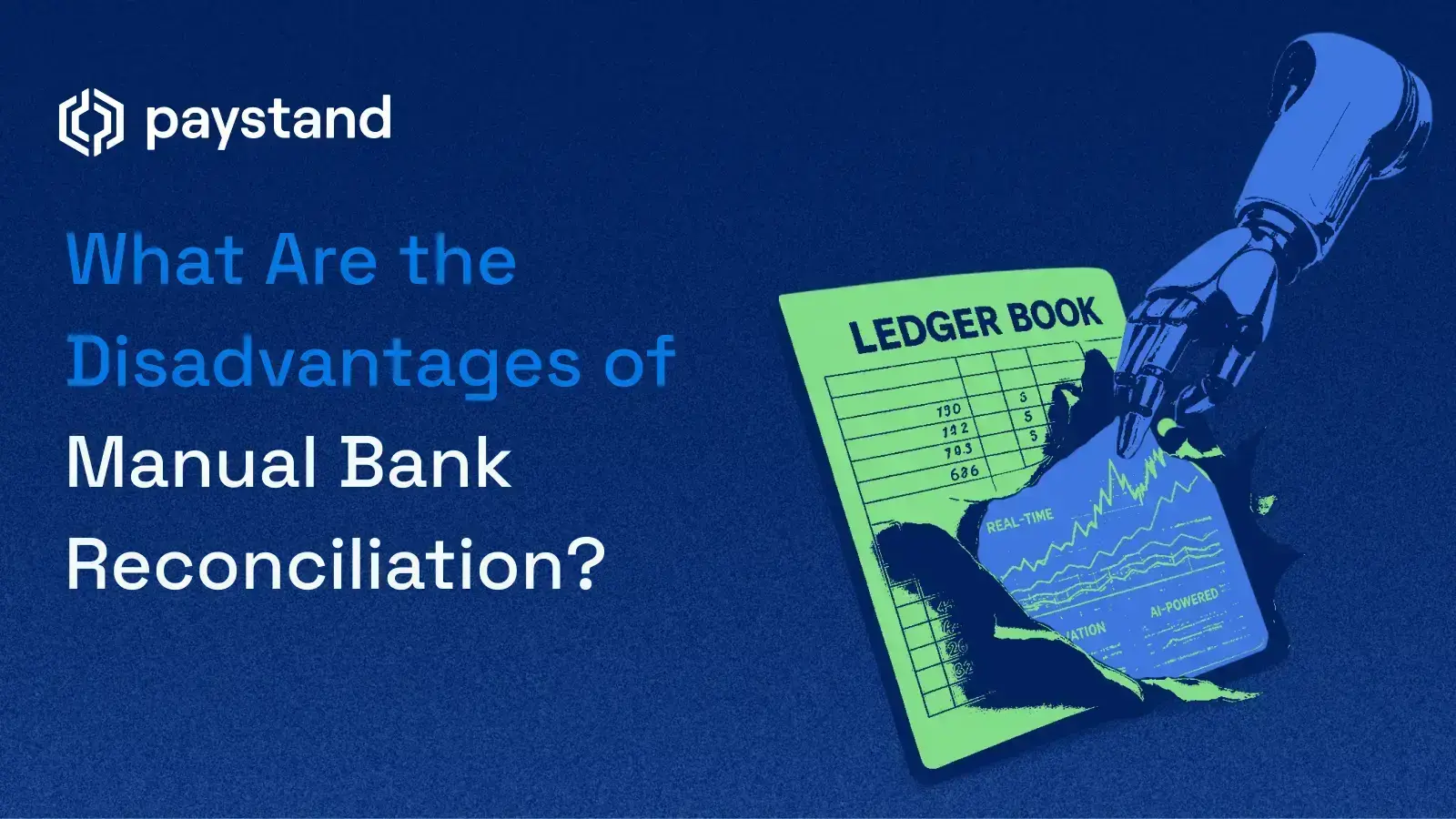
What Are the Disadvantages of Manual Bank Reconciliation?

What Are the Disadvantages of Manual Bank Reconciliation?

Table of Contents

  1. What is manual reconciliation?
  2. The truth about spreadsheets
  3. Why switch from manual to automated bank reconciliation?
  4. The true cost of manual bank reconciliation
  5. Why automated reconciliation is the best solution
  6. How to automate your reconciliation process
  7. How Paystand helps you break free from manual reconciliation


Key Takeaways

  • Manual bank reconciliation is outdated and prone to errors. It relies too much on spreadsheets that can't keep up with modern finance's speed and complexity.
  • Spreadsheets create data errors, version control issues, and delays, hindering finance teams' roles as strategic business partners.
  • Automating reconciliation streamlines processes by syncing data in real time, eliminating errors, and freeing time for higher-value financial tasks.
  • The true cost of manual reconciliation includes lost productivity, higher error risk, and potential compliance issues, increasing as businesses scale.
  • Paystand provides a blockchain-based automated reconciliation solution, replacing manual workflows with real-time visibility, smart payments, and no transaction fees.


In today’s fast-paced financial landscape, the difference between agility and inertia comes down to your processes. One process finance teams struggle with is manual bank reconciliation. While it seems a minor task, it reveals a tangled mess of spreadsheets, siloed data, and late nights chasing mismatches. This outdated, error-prone ritual burdens finance professionals everywhere.

A recent study found that 95% of businesses still use spreadsheets for their reconciliation process. This statistic should raise concerns. Spreadsheets are not designed for reconciliation. They have data entry errors, lack version control, and provide no real-time visibility. Most importantly, they don’t scale. Considering the time spent on manual processes and the risks of human error, the cost of sticking to the status quo is too high to ignore.

The finance world is transforming. Automation, AI, and blockchain challenge outdated systems. So, if your financial operations evolve, why is reconciliation stuck in the past? It’s time to explore the disadvantages of manual bank reconciliation and rethink what’s possible.


What Is Manual Reconciliation?

Manual reconciliation matches financial transactions across systems, usually bank statements and accounting records, to ensure accuracy. It involves cross-referencing ledgers, invoices, and spreadsheets to verify that debits and credits align. While this sounds straightforward, the reality is more complex.

This process is labor-intensive and prone to issues like delayed reporting and mistakes. It was designed for a slower world where monthly close cycles and paper-based reporting were the norm. In today's environment, where decisions must be made in real time and compliance demands are stricter than ever, this process introduces more friction than value.

Smarter Spend. Stronger Cash Flow.


The Truth About Spreadsheets

Spreadsheets are the duct tape of the finance world: always available, rarely ideal. Many finance teams lean on them out of habit, comfort, or a lack of better options. But here’s the truth: spreadsheets were never intended to support a modern reconciliation process.

They require constant manual input, increasing the risk of errors with every keystroke. A single misplaced digit or incorrect formula can distort financial records, skew reporting, and impact business decisions. There’s no real-time visibility, so teams always work with outdated numbers. And when multiple team members are involved, version control becomes a nightmare, introducing even more manual processes that complicate collaboration.

As finance teams become strategic advisors, spreadsheets shift from inconvenience to roadblock. Designed for static data, they hinder dynamic decision-making and slow business growth.


Why Switch from Manual to Automated Bank Reconciliation?

The shift to automated bank reconciliation isn’t just a trend, but a necessary evolution. Finance teams today are under pressure to deliver faster, more accurate results while managing growing volumes of data across an increasingly complex financial ecosystem.

Automation eliminates the guesswork. It streamlines your reconciliation process by syncing with your bank accounts and accounting systems to match transactions, flag anomalies, and generate reports automatically. The result is more time for strategic work and less time spent hunched over spreadsheets trying to find a $0.37 discrepancy.

As your business expands, the number of transactions increases. Manual reconciliation may work at 100 monthly transactions, but becomes unmanageable at 10,000. Automation provides the infrastructure to grow without sacrificing accuracy, control, or efficiency.


The True Cost of Manual Bank Reconciliation

Let’s put numbers behind the narrative. Manual account reconciliation takes time away from impactful financial analysis. Finance professionals waste 30-40% of their time on transaction matching and validation, losing hundreds of hours annually to routine checks. This time could be better spent improving profitability, forecasting, or identifying growth opportunities.

Errors are common in manual workflows, resulting in data entry errors and omissions that compound quickly. A single reconciliation error can disrupt financial statements, delay audits, and harm investor confidence. Inaccurate financial reporting may lead to costly compliance violations and penalties.

Manual reconciliation incurs productivity, financial, and reputational costs. As businesses become more complex, these costs will rise unless changes are made.


Why Automated Reconciliation Is the Best Solution

Bank reconciliation automation offers a fundamentally better way to manage your financial data. It doesn’t merely replicate your manual process; it replaces it with something far more powerful. Through AI, machine learning, and real-time data synchronization, automated reconciliation tools can analyze and match thousands of transactions in seconds, reducing the risk of errors and enhancing your overall financial accuracy.

The benefits don’t end with speed. Automation enhances compliance through audit-ready logs, better control over financial workflows, and improved cash flow forecasting. It also empowers finance professionals to focus on value-driven work, like scenario modeling and strategic planning, instead of endless cross-checking.

When compared side-by-side, the manual vs. automated bank reconciliation debate is no contest. One is reactive and error-prone, while the other is proactive, scalable, and intelligent.


How to Automate Your Reconciliation Process

Transitioning to automated reconciliation doesn’t have to be disruptive. Many companies start with a phased approach. Begin by mapping your reconciliation process and identifying where most errors or delays occur. This audit helps you understand what your future solution needs to address.

Next, select a platform that integrates with your existing systems. Seek features such as automated transaction matching, exception management, real-time dashboards, and audit trails. Robust business financial management capabilities and customer support are also essential.

From there, train your team to use the new tools and encourage adoption across departments. Finance automation works best when it’s holistic, combining accounting, treasury, and operations into a single streamlined process.
E book Industry pulse


How Paystand Helps You Break Free From Manual Reconciliation

Paystand is a future-focused fintech platform. We’ve replaced outdated workflows with a blockchain-powered, automated reconciliation system for clarity, control, and confidence.

Here’s how Paystand revolutionizes payment reconciliation:

  • Automated bank reconciliation: Transactions are instantly matched, saving hours of manual work.
  • End-to-end visibility: Real-time insights into your bank accounts and financial records.
  • Decentralized architecture: Built on blockchain for transparency and auditability.
  • Smart payments: Use programmable money via smart contracts to eliminate errors and delays.
  • No transaction fees: Ditch the legacy fees and reinvest that money into growth.

We're part of a new wave of financial infrastructure, like cryptocurrency, AI, and decentralized finance, that’s making traditional systems look like dial-up internet. If you still can’t see the disadvantages of manual reconciliation, you’re not just behind, you’re missing out. If you haven’t moved into the new wave, here’s how.

Still not sure if the leap is worth it? See how Edgewood Healthcare transformed its finance operations and reclaimed hundreds of hours using Paystand. You can find your business story in theirs.


Written by Zazil Martinez

10 years of content creation for digital platforms, as well as a creative lead for advertising, marketing campaigns, and copywriting

Share:

  • Follow us on Facebook
  • Follow us on Twitter
  • Follow us on Linkedin
  • Follow us on Pinterest

What is an Issuer in Payments? A Complete Guide

Previous Post

How CFOs Are Rewriting Their Playbooks Amid Tariffs and Tight Margins

Next Post
  • There are no suggestions because the search field is empty.

Subscribe Here!

Category

  • B2B Payments (112)
  • AR Optimization (96)
  • AR Automation (93)
  • Payment Processing (72)
  • Billing & Invoicing (71)

Popular Posts

Zazil Martinez 08/22/2024
What Is a TID Number? The Key to Secure Transactions
Analisa Flores 03/12/2025 Smart Lockbox
What is a Bank Lockbox Service and How is it Used for Payments?
Zazil Martinez 02/27/2025 B2B Payments, Billing & Invoicing, AR Optimization, AR Health
How to Improve Your Financial Decision Making?
Zazil Martinez 07/15/2024 Credit Cards
What is a Credit Card Hold? A Closer Look

Related Posts

NetSuite, Reconciliation
Zazil Martinez 31 March, 2025

What is NetSuite Bank Reconciliation, and How Does It Work?

Table of Contents What is NetSuite Bank Reconciliation? Why is Account Reconciliation Important?…

Read This Article
AR Automation, Reconciliation
Zazil Martinez 28 March, 2025

Optimizing Payment Reconciliation for Modern Finance Teams

Table of Contents

Read This Article
AR Automation, Payment Processing, Reconciliation, AR Optimization, AR Health
Zazil Martinez 24 March, 2025

Is AR Outsourcing the Right Move for Your Business?

Table of Contents

Read This Article

Paystand is on a mission to create a more open financial system, starting with B2B payments. Using blockchain and cloud technology, we pioneered Payments-as-a-Service to digitize and automate your entire cash lifecycle. Our software makes it possible to digitize receivables, automate processing, reduce time-to-cash, eliminate transaction fees, and enable new revenue.

  • Receivables
    • Automatic Reconciliation
    • Collections Automation
    • Payment Portal
    • Convenience Fees and Incentives
    • Billing & Receivables Automation
    • Dashboard & Reporting
    • NetSuite
    • Sage Intacct
    • Dynamics 365
    • Acumatica
    • Adobe Commerce
    • BigCommerce
    • Woo Commerce
    • Xero
    • All Integrations
  • Payables
    • AP Automation
    • Accounting Automation
    • International Payments
    • Purchase Order Approvals & Spend Approvals
    • Customer Portal
  • Legal
    • Privacy Policy
    • Terms of Service
  • Support
    • Knowledge Base
    • Developer Hub
  • Payments
    • B2B Payments
    • Paystand Bank Network
    • Check Scan
    • eCheck and ACH
    • Smart Lockbox
    • Canadian EFT
    • Push Payments: AI Match
  • Expense
    • Spend Management
    • Corporate Cards
    • Procurement
    • Spend Analytics
    • Slack
    • Microsoft Teams
    • Quickbooks Online
    • NetSuite
    • Sage Intacct
    • Microsoft Dynamics 365
    • All Integrations
  • Company
    • About Us
    • Payments as a Service
    • Become a Partner
    • Careers
    • Press
    • Sitemap
  • Resources
    • Blog
    • Case Studies
    • Datasheets
    • eGuides
    • Events
    • Podcast
    • Webinars
    • Glossary
  • INDUSTRIES
    • Healthcare
    • Manufacturing
    • Construction
    • Supply Chain
    • Solar Energies
    • Retail
    • Wholesale
  • DATA & INFRASTRUCTURE
    • Enterprise Blockchain
    • APIs
  • LEARNING RESOURCES
    • Improving Cash Flow
    • Optimizing Accounts Receivable
    • Reducing Costs

© Paystand, Inc. 2025. All Rights Reserved.