











paystand symbol white logoAR + PAYMENTS
|
AP + EXPENSE
|
LATAM AR + AP
|
FX + PAYOUTS
|
.org
  • Receivables

    ACCOUNTS RECEIVABLES

    • Automatic Reconciliation
    • Collections Automation
    • Payment Portal
    • Convenience Fees & Incentives
    • Billing & Receivables Automation
    • Dashboard & Reporting
    • NetSuite NetSuite
    • Sage Intacct Sage Intacct
    • Dynamics 365 Dynamics 365
    • Acumatica Acumatica
    • Adobe Commerce Adobe Commerce
    • BigCommerce BigCommerce
    • Woo Commerce Woo Commerce
    • Xero Xero
    • All Integrations All Integrations
  • Payables

    ACCOUNTS payables

    • AP Automation
    • Accounting Automation
    • International Payments
    • Purchase Order Approvals & Spend Approvals
    • Customer Portal

    WHY NOW

    Our push into Accounts Payables comes with our mission of becoming the one stop shop for the CFO.

    By integrating AP, our financial suite becomes even more powerful as we aim to automate everything money.

  • Payments

    OUR NETWORK

    Discover how we enable your business to receive fee-less payments at a faster speed than your current solution.

    We transition your costliest payers into cost-effective payment rails to return the most positive of ROIs.

    OVERVIEW

    • B2B Payments
    • Paystand Bank Network
    • Check Scan
    • eCheck and ACH
    • Smart Lockbox
    • Canadian EFT
    • Push Payments (AI Match)
  • Expense

    EXPENSE

    • Spend Management
    • Corporate Cards
    • Procurement
    • Spend Analytics
    • Slack Slack
    • Microsoft Teams Microsoft Teams
    • Quickbooks Online Quickbooks Online
    • NetSuite NetSuite
    • Sage Intacct Sage Intacct
    • Microsoft Dynamics 365 Microsoft Dynamics 365
    • All Integrations All Integrations
  • Resources
    • Blog
    • Case Studies
    • Glossary
    • Podcast
    • Events
    • Webinars
    • Datasheets
    • eGuides

    INDUSTRIES

    • Healthcare
    • Manufacturing
    • Construction
    • Supply Chain
    • Solar Energies
    • Retail
    • Wholesale

    DATA & INFRASTRUCTURE

    • Enterprise Blockchain
    • APIs

    LEARNING RESOURCES

    • Improving Cash Flow
    • Optimizing AR
    • Reducing Costs
    • Bitcoin at Paystand
  • Company

    Company

    Paystand is revolutionizing B2B payments with a modern infrastructure built as a SaaS on the blockchain, enabling faster, cheaper, and more secure business transactions.

    Our mission is to reboot commercial finance by creating an open financial system.

    Payments as a Service

    PARTNERS

    Join Paystand's partnership program today.

    Become a Partner

    PRESS

    Read about Paystand business updates and technology announcements.

    Read About Paystand

    CAREERS

    Join our fast-growing team of disruptors and visionaries.

    Grow With Paystand

    ABOUT US

    See how we are rebooting commercial finance.

    Learn About Our Mission

    Where We Operate

    United states

    USAPaystand is headquartered in California and operates nationwide, serving businesses across all 50 states.


    canada

    CANADAWe support operations in Canada with localized payment capabilities, including CAD EFT and cross-border support.

Bitcoin
Get Started
  • Login
  • Receivables
    • Automatic Reconciliation
    • Collections Automation
    • Payment Portal
    • Convenience Fees and Incentives
    • Billing & Receivables Automation
    • Dashboard & Reporting
    • NetSuite
    • Sage Intacct
    • Dynamics 365
    • Acumatica
    • Adobe Commerce
    • BigCommerce
    • WooCommerce
    • Xero
    • All Integrations
  • Expenses
    • Spend Management
    • Corporate Cards
    • Procurement
    • Spend Analytics
    • Slack
    • Microsoft Teams
    • Quickbooks Online
    • NetSuite
    • Sage Intacct
    • Microsoft Dynamics 365
    • All Integrations
  • Payables
    • AP Automation
    • Accounting Automation
    • International Payments
    • Purchase Order Approvals & Spend Approvals
    • Customer Portal
  • Payments
    • B2B Payments
    • Paystand Bank Network
    • Check Scan
    • eCheck and ACH
    • Smart Lockbox
    • Canadian EFT
    • Push Payments: AI Match
  • Resources
    • Blog
    • Case Studies
    • Datasheets
    • eGuides
    • Events
    • Webinars
    • Glossary
    • Podcasts
    • Improving Cash Flow
    • Optimizing AR
    • Reducing Costs
    • Bitcoin at Paystand
    • The Future of Finance - Get Your Copy
    • Enterprise Blockchain
    • APIs
  • Industries
    • Healthcare
    • Manufacturing
    • Construction
    • Supply Chain
    • Retail
    • Solar
    • Wholesale
  • Company
    • Abous Us
    • Payments as a Service
    • Become a Partner
    • Press
    • Careers
  • Login
  • Get Started
Zazil Martinez 10/20/2023
3 Minutes

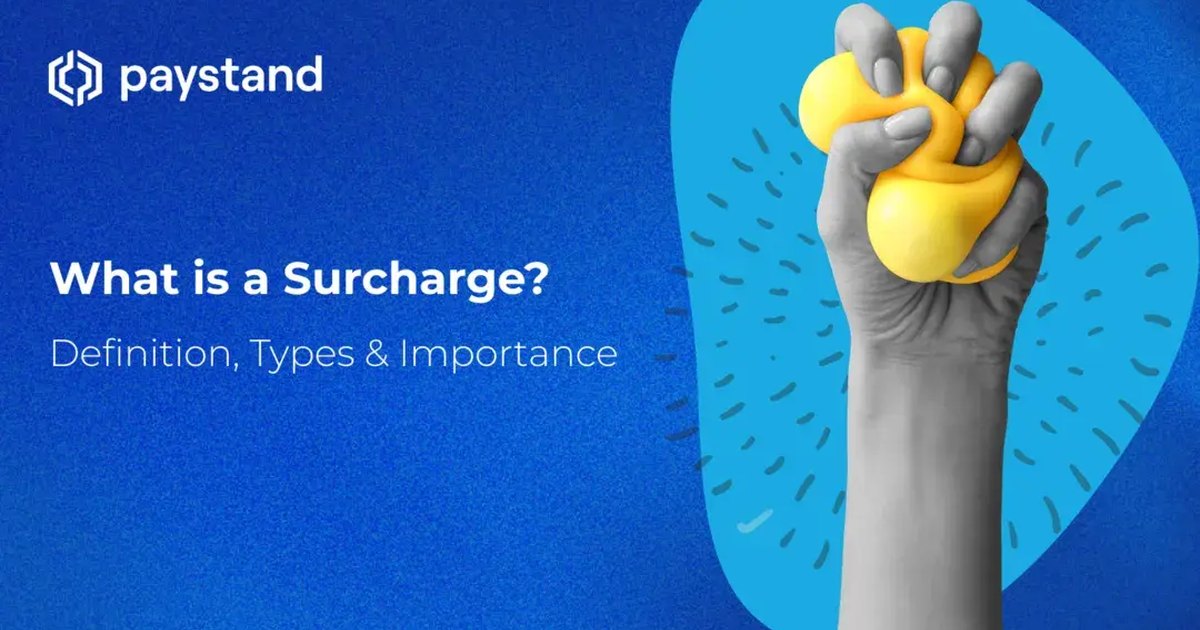
What is a Surcharge? Definition, Types & Importance

What is a Surcharge? Definition, Types & Importance

Note: This article is for informational purposes only and does not constitute legal advice. Paystand offers several methods to help offset or eliminate transaction fees. Surcharging is not one of those methods. 


Table of Contents

  1. What are surcharges?
  2. What types of entities impose surcharges?
  3. What are credit card surcharges?
  4. What are bank surcharges?
  5. What is a broadcast TV surcharge?
  6. Why is it important to understand surcharges?


Key Takeaways

  • A surcharge is an additional fee added to the cost of a good or service that is not typically included in the original price. It is displayed as a separate line item on receipts. 
  • Governments, businesses, and industries impose surcharges to cover fuel, regulatory fees, and specific service expenses. 
  • Credit card surcharges help merchants offset interchange fees but are subject to legal requirements, with restrictions on surcharging in certain U.S. states. 
  • ATM fees are considered surcharges, typically applied per transaction, often waived for users of the sponsoring bank’s ATMs. 
  • Cable companies may pass on broadcast TV surcharges from networks to customers, appearing as monthly fees. 
  • Understanding surcharges is essential for businesses and consumers to plan finances and anticipate additional costs beyond the base price of goods and services.


What Are Surcharges?

A surcharge is an additional fee, charge, or tax that is added to the cost of a good or service. Surcharges are typically not quoted in the original price of the sold item and are usually added during checkout.

The exact amount of every surcharge varies. It can either be a fixed amount or a percentage of the total amount of the purchase itself. Surcharges are only added to the retail price of the purchase, so it is not taxable. This charge will always appear as a separate line item on your receipt. The calculated surcharge fee will appear in the contract or sales and purchase agreement (SPA).

New call-to-action

What Types of Entities Impose Surcharges?

Many entities– governments, businesses, and service professionals – will impose surcharges. Industries, including travel, telecom, and cable, will add surcharges to offset the cost of essential things they will inevitably have to spend money on, such as fuel or regulatory fees imposed by the government through local, state, or federal regulations. Often, when these costs increase, companies might adjust surcharge amounts instead of the price of the products or services themselves.

For example, cab drivers may add a fuel surcharge of $1 if gas prices increase. Additionally, cable companies might add regulatory recovery fees to their customers’ bills to offset the burden of specific service fees imposed by government entities. Other examples include emergency service fees on phone services, disposal and handling fees for electronics, hazardous waste disposal fees at the veterinarian’s office, and minimum transaction fees or interchange fee charges for debit or credit card payments. In this way, the fees are passed along to the customers but more directly than if the product or service itself was marked up to cover the cost of the business.


What Are Credit Card Surcharges?

Some merchants elect to add credit card surcharges to purchases to cover the cost of interchange fees. Interchange fees are the transaction fees taken from the merchant whenever a customer uses a credit card to make a purchase. These fees go to the card networks to cover the cost of processing payments, guarding against fraud, and covering any transaction risks. Interchange fees can be as high as 3.5%, meaning merchants might charge a surcharge fee of 3.5% to cover the cost of the interchange fee. However, it’s important to note that merchants who choose to surcharge must follow consumer disclosure and other requirements agreed to as part of the settlement. On top of that, depending on the card network they’re working with, merchants must notify the network of their intent to add surcharges at least thirty days before surcharging.

While adding surcharges to cover the cost of interchange fees is not considered illegal, companies cannot pass these fees to customers in certain jurisdictions within the US. These areas include Massachusetts, Connecticut, and Puerto Rico.

On the other hand, anti-surcharging laws cannot be enforced in California, Kansas, Maine, Florida, New York, Oklahoma, Texas, and Utah. In 2017, the Supreme Court prohibited New York State from stopping credit card surcharges, ruling that the fees fall under free and protected speech for credit card companies.


What Are Bank Surcharges?

When consumers use their payment cards at an automated teller machine (more commonly known as an ATM), they must pay a fee to withdraw their cash. This fee is a surcharge, shown as a set dollar amount per transaction. ATM fees are often levied by the bank or another institution that owns and operates the machine, but most ATM providers waive fees for customers of the sponsoring ATM.
Adobe commerce


What Is a Broadcast TV Surcharge?

TV networks can impose broadcast TV surcharges on cable providers to carry their signals over the airwaves. Federal law ensures that these fees are negotiable between networks and cable companies. Instead of increasing the price of the entire service, the surcharge is passed on to cable company customers each month.


Why Is it Important to Understand Surcharges?

Many customers accept surcharges without thinking much about them or why an added cost is tacked onto their purchase. Businesses and consumers must understand surcharges and their origins for budgeting and accounting purposes. Remember, surcharges are either a fixed amount or a percentage of the purchase price. They come in many forms, including handling, service, disposal, and processing fees. The service provider or another entity, including the government, may impose them.

While surcharges are unavoidable for many customers, understanding where they come from and what they entail can help when strategically planning your finances.


Written by Zazil Martinez

10 years of content creation for digital platforms, as well as a creative lead for advertising, marketing campaigns, and copywriting

Share:

  • Follow us on Facebook
  • Follow us on Twitter
  • Follow us on Linkedin
  • Follow us on Pinterest

Paystand Announces Gold Level Sponsorship of SuiteWorld 2023

Previous Post

How Interchange Fees Work and How You Can Avoid Them

Next Post
  • There are no suggestions because the search field is empty.

Subscribe Here!

Category

  • B2B Payments (112)
  • AR Optimization (96)
  • AR Automation (93)
  • Payment Processing (72)
  • Billing & Invoicing (71)

Popular Posts

Zazil Martinez 08/22/2024
What Is a TID Number? The Key to Secure Transactions
Analisa Flores 03/12/2025 Smart Lockbox
What is a Bank Lockbox Service and How is it Used for Payments?
Zazil Martinez 02/27/2025 B2B Payments, Billing & Invoicing, AR Optimization, AR Health
How to Improve Your Financial Decision Making?
Zazil Martinez 07/15/2024 Credit Cards
What is a Credit Card Hold? A Closer Look

Paystand is on a mission to create a more open financial system, starting with B2B payments. Using blockchain and cloud technology, we pioneered Payments-as-a-Service to digitize and automate your entire cash lifecycle. Our software makes it possible to digitize receivables, automate processing, reduce time-to-cash, eliminate transaction fees, and enable new revenue.

  • Receivables
    • Automatic Reconciliation
    • Collections Automation
    • Payment Portal
    • Convenience Fees and Incentives
    • Billing & Receivables Automation
    • Dashboard & Reporting
    • NetSuite
    • Sage Intacct
    • Dynamics 365
    • Acumatica
    • Adobe Commerce
    • BigCommerce
    • Woo Commerce
    • Xero
    • All Integrations
  • Payables
    • AP Automation
    • Accounting Automation
    • International Payments
    • Purchase Order Approvals & Spend Approvals
    • Customer Portal
  • Legal
    • Privacy Policy
    • Terms of Service
  • Support
    • Knowledge Base
    • Developer Hub
  • Payments
    • B2B Payments
    • Paystand Bank Network
    • Check Scan
    • eCheck and ACH
    • Smart Lockbox
    • Canadian EFT
    • Push Payments: AI Match
  • Expense
    • Spend Management
    • Corporate Cards
    • Procurement
    • Spend Analytics
    • Slack
    • Microsoft Teams
    • Quickbooks Online
    • NetSuite
    • Sage Intacct
    • Microsoft Dynamics 365
    • All Integrations
  • Company
    • About Us
    • Payments as a Service
    • Become a Partner
    • Careers
    • Press
    • Sitemap
  • Resources
    • Blog
    • Case Studies
    • Datasheets
    • eGuides
    • Events
    • Podcast
    • Webinars
    • Glossary
  • INDUSTRIES
    • Healthcare
    • Manufacturing
    • Construction
    • Supply Chain
    • Solar Energies
    • Retail
    • Wholesale
  • DATA & INFRASTRUCTURE
    • Enterprise Blockchain
    • APIs
  • LEARNING RESOURCES
    • Improving Cash Flow
    • Optimizing Accounts Receivable
    • Reducing Costs

© Paystand, Inc. 2025. All Rights Reserved.