












Table of Contents
Key Takeaways
- Traditional cross-border B2B payments silently consume 2.5 to 6 percent of every transaction in wire and FX fees, while settlement delays and manual compliance checks compound the hidden cost further.
- Blockchain's architecture—cryptographically chained blocks validated across thousands of independent nodes—eliminates the central intermediaries responsible for those layered fees and reconciliation burdens.
- On Paystand's agentic network, digital agents automate compliance screening and cash matching while USDb locks FX at approval and settles same-day — the decision and the payment become one event.
- Paystand's agentic B2B payment network replaces the legacy wire with $0 wire fees, FX locked at approval, and same-day settlement across 190-plus countries.
Every international payout costs you 2.5 to 6 percent to wire and FX fees buried in the spread, rarely surfaced as a line item. Settlement timing often shifts between approval and execution.
Legacy rails imposed these costs decades ago and never changed. Blockchain changes the underlying infrastructure: it removes intermediaries, locks FX at approval, and cuts cross-border fees in half.
By the end of this article, you'll understand how and what you can do differently.
What Is Blockchain Technology?
Blockchain is a distributed digital ledger of cryptographically signed transactions grouped into blocks. Each block links to the one before it, making older records progressively harder to alter as the chain grows.
No single institution controls it. Every participating node holds a copy, and the network validates each new block before it joins the chain.
That architecture produces something finance teams can act on: a record that doesn't require a trusted intermediary to confirm it's accurate. You can verify it, audit it, and build workflows on top of it without reconciling against a counterparty's version of the same transaction.
How Blockchain Records and Chains Transactions
A transaction initiates, gets cryptographically hashed into a unique fingerprint, and bundles with other pending transactions into a block.
The network then validates that block — confirming no funds are spent twice — before appending it permanently to the chain. Bitcoin transactions, for example, reach finality after approximately five confirmed blocks, roughly one hour.
That sequence is what you rely on: every payment you send enters a verifiable, tamper-evident record the moment the network agrees it's legitimate.
How Blockchain Works
Every blockchain transaction follows the same four-step sequence: a transaction initiates, gets packaged into a block, earns network validation through consensus, and locks permanently into the chain.
Recording Transactions as Blocks
Each block packages a batch of transactions, stores a unique cryptographic hash, and records a timestamp linked to the preceding block. That chain of references gives you a verifiable, sequential audit trail: one you can trace back to any transaction without relying on a third party.
Reaching Consensus Across Nodes
No single authority decides which transactions are valid. Instead, thousands of independent nodes apply the same rule set simultaneously. They agree on the correct chain state, preventing double-spending, and eliminating conflicting ledger histories without any central gatekeeper.
Linking the Blocks
Each block contains the hash of the block before it. Alter one record and you force recomputation of every block that follows: a task no practical attacker can complete.
Sharing the Distributed Ledger
Every node stores a complete copy. To corrupt the ledger, an attacker must simultaneously overwrite thousands of independent copies: a practically impossible task that keeps your financial records exactly as you recorded them.
The End-to-End Transaction Process
A transaction initiates, hashes into a block, clears consensus, links to the chain, and distributes across every node: each step locking the record you rely on.
Key Features That Make Blockchain Different
The mechanics we just covered (hashing, consensus, distributed storage) produce five properties that change what a CFO can verify, control, and eliminate from their cost structure.
Decentralization: No Single Point of Control
Decentralization prevents any single actor from altering or withholding your records. The ledger distributes across thousands of nodes simultaneously, so you eliminate the single point of failure entirely.
Transparency and Real-Time Visibility
Blockchain gives you a live view of every transaction. No waiting until month-end to find out where cash stands. On public blockchains, every participant sees every transaction in real time. On permissioned networks, visibility is selective but still immediate.
CFOs track payment status, verify settlement, and catch discrepancies the moment they occur, collapsing the reconciliation bottleneck from weeks to hours.
Immutability and Tamper-Resistant Records
Confirmed records cannot be quietly rewritten. Once a block is added to the chain, altering it forces recomputation of every subsequent block across every node, a task no bad actor can practically complete.
That mechanism is what lets you enter an audit with a complete, verifiable transaction history, resolve a disputed payment without manual reconstruction, and finalize statements without chasing down conflicting records.
Consensus Mechanisms (PoW, PoS, DPoS, PoA, BFT)
Not all consensus mechanisms work the same way. The tradeoff you accept shapes everything from settlement speed to energy cost.
- Proof of work or PoW prioritizes security; you trade energy for tamper resistance.
- Proof of stake or PoS reduces energy use; validators stake collateral instead of burning compute.
- Delegated proof of stake or DPoS elects delegates, accelerating validation speed.
- Proof of authority or PoA restricts validation to approved participants, maximizing throughput.
- Byzantine fault tolerance or BFT tolerates node failures without halting the network.
The Role of Blockchain Nodes
Every computer participating in the blockchain network is a node. Nodes store, validate, and relay transactions. When one participant's system goes offline, every other node still holds a complete, accurate copy of the ledger.
An attacker cannot corrupt the record by targeting a single server; they must simultaneously compromise thousands of independent copies.
Core Components of Blockchain Technology
Three components turn blockchain's architecture into something a CFO can rely on: a distributed ledger that eliminates the central administrator, public key cryptography and hashing that authenticate every transaction without a third party, and smart contracts that trigger finance workflows automatically when conditions are met.
Distributed Ledger Technology
Blockchain and DLT are not the same thing. DLT is the broader category: any system that stores and synchronizes records across multiple locations without a central administrator.
Blockchain is one type of DLT, distinguished by cryptographically chained blocks, immutable records, transparent transaction history, and smart-contract capability. Removing that central administrator eliminates the reconciliation steps your team currently performs to resolve conflicting copies.
Public Key Cryptography and Hashing
Public key cryptography authenticates every transaction without revealing the sender's identity. Each participant holds a private key that signs outgoing payments and a public key that counterparties use to verify them, eliminating the need for a bank or processor to confirm who sent what.
Hashing converts every transaction into a fixed-length fingerprint: change one character, and the fingerprint changes entirely, making tampering immediately detectable.
Smart Contracts: Self-Executing Finance Workflows
Smart contracts are self-executing programs stored on the blockchain that trigger automatically when predefined conditions are met. In a B2B context, that means invoice payment, cash application, and ERP reconciliation posting happen in the same moment.
Money moves. The ledger updates. Manual matching steps disappear. CFOs deploy this logic to eliminate reconciliation lag entirely.
Types of Blockchain Networks
Not all blockchain networks are built the same, and the differences matter when you're choosing infrastructure, not just evaluating a concept. Public, private, consortium, and hybrid networks each make different tradeoffs between openness, control, and speed.
Public Blockchain Networks
Public blockchains, Bitcoin and Ethereum are the standard examples, let anyone participate, validate transactions, and view the full ledger without permission. That openness delivers maximum decentralization. It also exposes transaction data publicly and limits throughput.
Private Blockchain Networks
A single organization controls a private blockchain, setting access rules, validating transactions, and managing the ledger without external participants. That control compresses settlement cycles and reduces reconciliation overhead, giving finance teams cleaner data at close.
CFOs select private blockchains when auditability matters but public visibility creates compliance or competitive exposure.
Consortium Blockchain Networks
A consortium blockchain distributes governance across a defined group of organizations where no single entity controls the ledger. Banks settling interbank transactions, manufacturers tracking invoices across a supplier network, or insurers sharing claims data can all write to the same ledger without exposing it publicly.
Hybrid Blockchain Networks
Hybrid blockchains combine public and private networks into one architecture. CFOs choose which data stays public and verifiable and which stays restricted, such as counterparty terms or transaction amounts.
This separation protects confidential commercial relationships while keeping regulators and auditors able to verify exactly what they need.
Is Blockchain Secure?
Blockchain resists tampering structurally because altering any record requires recomputing every subsequent block across every node simultaneously. That architectural reality translates directly into outcomes CFOs can act on: a ledger they verify without manual reconciliation, audits they close faster, and records that likely reduce disputes before they start.
How Cryptography and Consensus Prevent Tampering and Double-Spending
Hashing detects tampering instantly. Consensus rejects the rest. Together, they form a two-layer defense: any altered record produces a mismatched hash the network flags immediately, while consensus prevents any single actor from forcing a fraudulent transaction without network-wide agreement.
Why Immutable Records Deliver a Single Source of Truth
A confirmed record cannot be quietly edited. Immutability eliminates the version-control problem that breaks spreadsheet-dependent close processes. When the ledger cannot change after settlement, the CFO reconciles against a fixed truth, not a moving one. Autonomous cash application only works if that foundation holds.
Faster, Cleaner Auditing for the Office of the CFO
Immutable records transform audits: CFOs retrieve transactions rather than reconstruct them. When the record cannot be quietly altered, you close faster and enter audits prepared, freeing your team to focus forward instead of looking back.
Blockchain and the Cost of Moving Money in B2B
B2B payment rails were built decades ago, and the cost of using them doesn't appear as a single line item. You pay to move money, pay again in reconciliation labor, and pay a third time in settlement delays that idle your capital.
Why Traditional Payment Rails Add Fees at Every Step
Every transaction costs you three times. First, you pay the fee to move money via the card network markup, processor cut, and wire intermediary charge.
Second, your team pays in labor: matching deposits to invoices, chasing exceptions, correcting coding errors.
Third, approval delays and settlement lag stretch your close cycle while idle capital compounds quietly in the gap.
How On-Chain Rails Cut Cost-to-Collect and Speed Settlement
On-chain rails remove the intermediary. They also remove the fee. Bank-to-bank rails bypass card networks and processors entirely, eliminating the first cost layer, while self-reconciling settlement eliminates the manual matching labor that generates the second.
The Paystand agentic B2B payment network runs on this model: zero transaction fees, same-day settlement versus ACH's typical two-to-five days, and per-transaction costs that stop scaling with revenue.
Covetrus cut its DSO by 80 percent and per-transaction fees by 98 percent thanks to this mechanism.
Benefits of Blockchain for Cross-Border Payments and Treasury
Cross-border payments hide their cost. Fees embed in FX spreads, wire intermediaries extract margin at every hop, and settlement timing shifts between approval and execution.
Eliminating Hidden FX and Wire Fees (2.5–6%)
Wire and FX fees typically consume 2.5 to 6 percent of every cross-border transaction embedded in the spread, not surfaced as a line item, which makes them easy to undercount.
USDb, a digital dollar built for business, settles payments directly between parties, removing correspondent bank intermediaries entirely.
Same-Day Settlement and FX Locked at Approval
On legacy rails, FX rates apply at settlement, not approval. The rate you authorized on Monday becomes the rate the market sets on Wednesday. Treasury teams don't eliminate that exposure; they budget around it with buffers and hedges.
On-chain rails change the tradeoff entirely. Rates lock at approval. Exposure ends there. You settle same-day across 190+ countries, and the cost you approved is the cost you pay.
Automated Compliance: Dual Approval and OFAC Screening
Manual compliance appends checklists after payments initiate. That gap is where errors enter.
On-chain rails embed dual approval and OFAC screening directly into the execution layer. The CFO sets which controls to embed and reviews what the system flags. Digital agents running inside the network handle screening on every payment, so control sits in the execution layer instead of a manual checklist bolted on afterward.
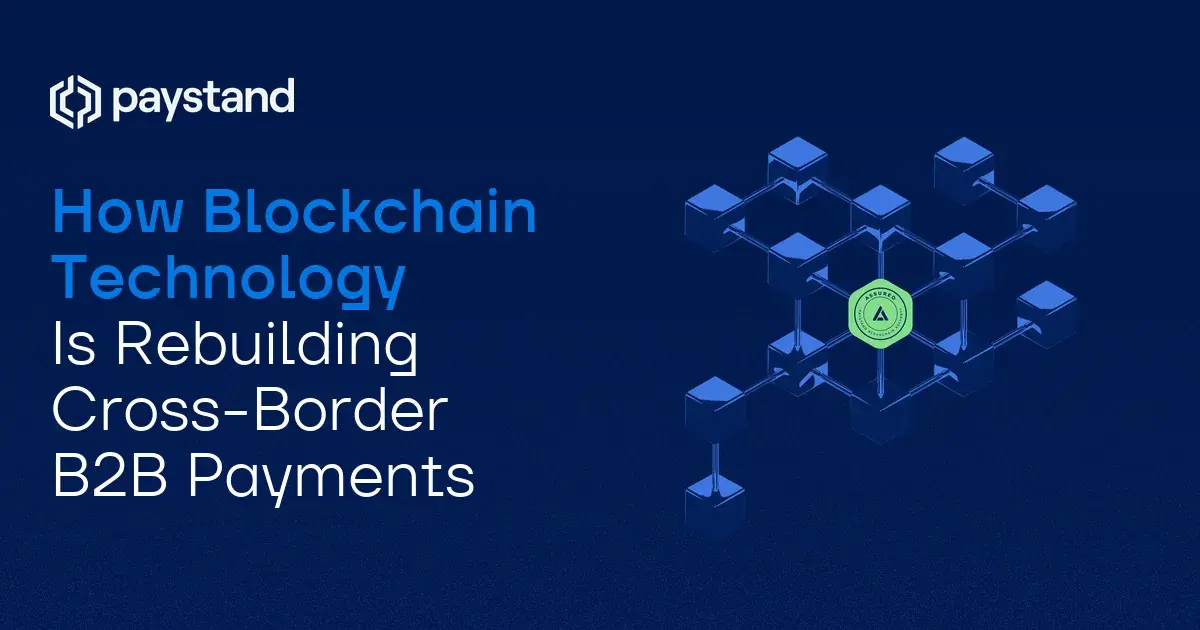
How Blockchain Is Rebuilding Cross-Border B2B Payments
Paystand's agentic B2B payment network addresses unpredictable FX fees, manual compliance checklists, and slow settlement at the rail level. Digital agents do the work and USDb settles the funds, instead of a patch bolted onto a rail someone else owns.
- Vendor Payouts locks the FX rate at approval, not at send — the rate you approve is the rate the vendor receives.
- Autonomous dual-approval and OFAC screening run on every payout automatically — no manual checklists, no compliance gaps at execution.
- The network settles same-day across more than 190 countries on local rails — PIX in Brazil, SEPA in the Eurozone, UPI in India, SPEI in Mexico.
- $0 wire fees and FX locked at approval replace the per-wire charges, correspondent-bank cuts, and 2.5–6% hidden FX spread on every international payment.
- USDb settles directly to local bank deposits in the recipient's currency: the vendor is paid into their existing bank account and never sees or touches the rail.
If cross-border payment costs are increasingly eating into your margins, explore how Paystand's enterprise blockchain can help you cut costs while increasing security.