















Table of Contents
- What is working capital?
- Where does working capital come from?
- How do I calculate working capital?
- How to improve working capital in business financial management
- Enhancing financial resilience through automation
Key Takeaways
- Working capital measures a company's ability to meet short-term obligations. It refers to the funds required to keep daily operations running smoothly.
- Key factors affecting working capital include sales, inventory, accounts payable, and accounts receivable.
- Calculating working capital requires identifying current assets and liabilities and then subtracting liabilities from assets.
- Positive working capital indicates financial health, while negative suggests potential financial distress.
- Strategies to improve working capital include managing inventory efficiently, optimizing accounts receivable and accounts payable, and implementing cost control measures.
- Automation can enhance working capital management, streamline processes, and improve financial resilience.
In a landscape where each financial decision could pivot a business from thriving to merely surviving, optimizing working capital isn't just beneficial—it's essential. As the economy demands real-time responsiveness, today's business financial management requires leaders to make sharper, faster decisions beyond traditional strategies.
With it at its core, companies that master liquidity management and harness finance digital transformation have the power to drive long-term growth and operational resilience.
Ready to revolutionize your approach to financial management? Read on to uncover strategies that strengthen and position your business for a more dynamic financial future.
What is Working Capital?
Working capital is a crucial financial metric that measures a company's ability to meet its short-term obligations. It is calculated by subtracting current liabilities from current assets. Current assets can be quickly converted into cash, such as cash on hand, accounts receivable, and inventory. On the other hand, current liabilities are debts due within one year, such as accounts payable, short-term loans, and accrued expenses.
Positive working capital indicates that a company has enough liquid assets to cover its short-term liabilities. This is important because it allows a company to operate smoothly and avoid financial distress. Negative working capital, on the other hand, indicates that a company does not have enough liquid assets to cover its short-term liabilities. This can be a sign of financial distress and can lead to bankruptcy.
Several factors can affect a company's working capital, including:
- Sales: Strong sales lead to higher working capital due to cash generation for liability payments and current asset investments.
- Inventory: Companies with more inventory generally have lower working capital than those with less, as inventory is a current asset but not as liquid as cash or accounts receivable.
- Accounts payable: More accounts payable means lower working capital due to current liability requirements.
- Accounts receivable: Higher accounts receivable typically result in higher working capital due to quick conversion into cash.
In finance digital transformation, businesses increasingly leverage technology to monitor and manage working capital, optimizing cash flow and operational efficiency.

Why is it Called Working Capital?
The term is used because it represents the funds a business needs to keep its daily operations "working" smoothly. These funds help cover routine expenses such as wages, raw materials, and other operational costs. Essentially, it keeps the business in motion, allowing it to function without interruption.
Is Working Capital the Same as Equity?
No, working capital and equity are not the same. While both are important financial concepts, they represent different aspects of a company's financial health.
| Working Capital | Equity | |
|---|---|---|
| Definition | Difference between current assets and current liabilities | Difference between assets and liabilities |
| Measurement | Short-term liquidity | Ownership interest |
| Positive Value | Enough current assets to cover current liabilities | More assets than liabilities |
| Negative Value | Not enough current assets to cover current liabilities | More liabilities than assets |
💡Key Differences
- Working capital is a measure of short-term liquidity, while equity is a measure of ownership interest.
- Working capital is calculated as current assets minus current liabilities, while equity is calculated as assets minus liabilities.
- Working capital can impact a company's ability to meet its short-term obligations, while equity can affect its ability to attract investors and raise capital.
Where Does Working Capital Come From?
Working capital is the lifeblood of any business. It covers a business's day-to-day operations, such as paying employees, purchasing inventory, and marketing products or services. Without it, a company can quickly run into financial trouble.
Internal Sources
- Retained earnings: When a company makes a profit, it can keep some of those earnings. This money can then be used to fund working capital needs.
- Depreciation and amortization: When a company purchases an asset, it can depreciate or amortize its cost over time. This creates a tax deduction that can be used to generate cash flow.
- Accounts payable: A company can extend its payment terms to its suppliers, giving it more time to pay its bills. This can free up cash that can be used for working capital needs.
External Sources
- Short-term loans: A company can borrow money from a bank or other lender to cover its working capital needs. These loans typically have a term of one year or less.
- Lines of credit: A company can also obtain a line of credit from a bank or other lender. This allows the company to borrow up to a certain limit as needed.
- Factoring: A company can sell its accounts receivable to a factoring company at a discount. This will give the company immediate cash flow and incur a factoring fee.
- Venture capital: A company can raise money from venture capitalists to fund its working capital needs. Venture capitalists fund early-stage companies in exchange for an equity stake.
The best source of working capital for a company will depend on its circumstances. Some companies may find that borrowing money from a bank is more cost-effective, while others prefer internal funding sources. Businesses should carefully consider their options and choose their working capital source.
The Three Components of Working Capital
To fully understand working capital, it's essential to recognize its three main components:
-
Cash and cash equivalents: This is the most liquid asset and is crucial for covering immediate expenses.
-
Accounts receivable are payments owed to the business by customers. Efficient management of accounts receivable can significantly improve a company's cash flow.
-
Inventory: While inventory is an asset, it is less liquid. Managing inventory effectively helps avoid excessive stock, which can tie up cash that could be used elsewhere.
A well-managed balance of these components is vital for maintaining healthy working capital and achieving improved financial decision-making.
How Do I Calculate Working Capital?
To calculate working capital, follow these steps:
-
Gather the necessary information: You will need the company's balance sheet, which contains its current assets and liabilities.
-
Calculate current assets: Current assets include cash, accounts receivable, inventory, and other assets that can be easily converted into cash.
-
Calculate current liabilities: Current liabilities include accounts payable, short-term loans, accrued expenses, and other liabilities that must be paid within one year.
-
Subtract current liabilities from current assets: The result is the company's working capital.
Here is an example of how to calculate working capital:
- Current assets: $100,000
- Current liabilities: $50,000
- Working capital: $50,000
This company has a positive working capital of $50,000, which means it has enough current assets to cover its current liabilities.
What is the Normal Working Capital?
A "normal" level varies by industry and company size. However, positive working capital (where current assets exceed current liabilities) is generally seen as a good sign of financial health. Businesses with low or negative working capital may struggle to meet obligations, risking disruptions to operations and financial instability. Tracking and optimizing working capital is key to effective business financial management and helps avoid costly liquidity shortages.
How to Improve Working Capital in Business Financial Management
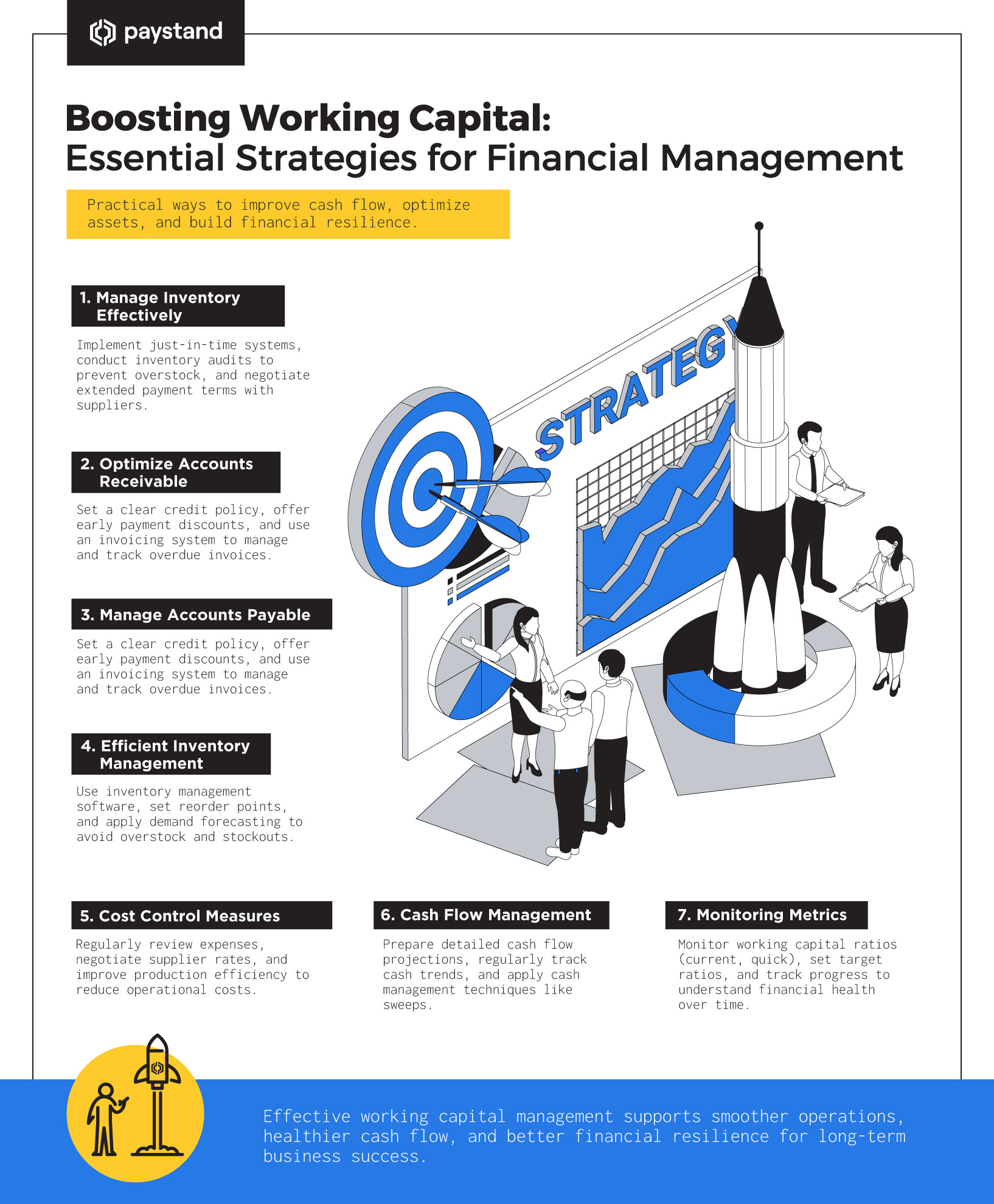
- Manage inventory effectively: Implement just-in-time inventory systems, conduct regular audits to prevent overstocking and identify slow-moving items, and negotiate favorable payment terms with suppliers to extend payment periods.
- Optimize accounts receivable: Establish a clear credit policy, offer early payment discounts, implement an efficient invoicing system, and monitor accounts receivable aging reports to address overdue invoices proactively.
- Manage accounts payable: Negotiate extended payment terms, promptly pay invoices to avoid penalties, and implement a centralized accounts payable system for improved efficiency and payment control.
- Efficient inventory management: Implement inventory management software to track inventory levels and optimize ordering, use inventory forecasting techniques to predict future demand and avoid overstocking, and establish reorder points to ensure timely replenishment without excessive stock.
- Cost control measures: Analyze operating expenses to find potential savings, negotiate better rates with vendors for supplies, services, and utilities, and implement cost-effective production processes and technologies to minimize manufacturing costs.
- Cash flow management: Prepare detailed projections, monitor cash flow regularly to identify trends and potential issues, and implement cash management strategies like sweeps and concentration accounts to optimize cash availability.
- Monitoring metrics: Working capital ratios, such as current and quick ratios, should be monitored regularly, targets for these ratios set, and progress tracked over time to assess a company's liquidity and financial health.
By implementing these strategies, businesses can improve their position, enhance liquidity, and achieve sustainable financial growth.
Enhancing Financial Resilience through Automation
A well-managed working capital strategy, enhanced by automation, is a powerful tool for any business seeking to improve financial decision-making and streamline processes.
With automation platforms like Paystand, organizations can gain better control over cash flow, reduce manual errors, and expedite payments. By adopting these advanced solutions, companies can accelerate digital finance transformation, strengthen their financial foundation, and prepare for future growth.
Want to know more about how automation can improve your financial decision-making and free up valuable resources? Download our full ebook here to uncover the benefits of finance automation for your role and organization.